
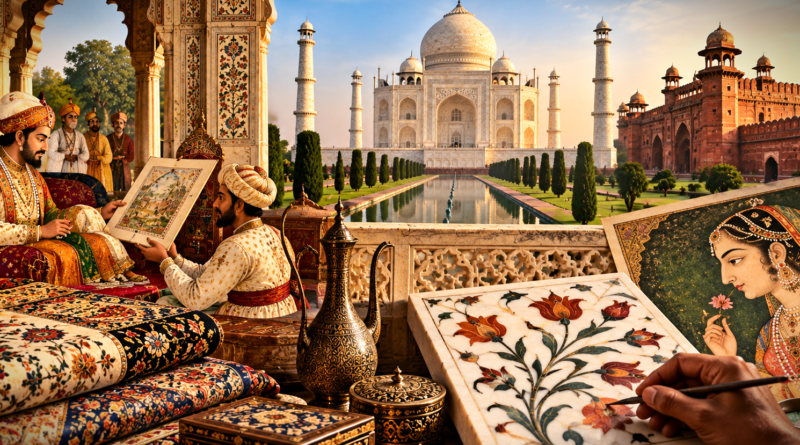
The Influence of Mughal Art on Indian Culture – India Times Group
Introduction
India’s cultural identity has been shaped by centuries of artistic creativity, cultural exchange, and historical transformation. Among the many influences that have contributed to its rich heritage, Mughal art holds a particularly significant place. Emerging during the Mughal Empire, which began in the Indian subcontinent in the early sixteenth century, this artistic tradition combined Persian influences with Indian craftsmanship, regional aesthetics, and ideas brought from Central Asia. Over time, it developed into a distinctive style that transformed architecture, painting, decorative arts, gardens, textiles, and several other aspects of Indian cultural life.
Mughal art was not simply an expression of royal wealth or imperial power. It also reflected the society in which artists, architects, craftsmen, scholars, and artisans interacted across cultural boundaries. Their work created artistic traditions that continued long after the empire declined. From magnificent monuments and detailed miniature paintings to elegant gardens and intricate decorative patterns, Mughal creativity became an enduring part of India’s cultural landscape.
Understanding the influence of Mughal art helps explain how different traditions can meet, evolve, and produce something new. Its legacy remains visible in historical monuments, museums, handicrafts, traditional designs, and contemporary artistic expression throughout India.
The Origins and Development of Mughal Art
Mughal art developed under rulers whose cultural backgrounds connected the Indian subcontinent with Persia and Central Asia. When Babur established Mughal rule in 1526, he brought with him an appreciation for gardens, architecture, literature, and refined artistic traditions. However, the artistic culture that emerged under his successors was not merely an extension of foreign influences. It gradually absorbed Indian materials, techniques, beliefs, and regional artistic practices.
Emperor Akbar played an especially important role in encouraging this development. His court brought together painters, architects, calligraphers, and craftsmen from different backgrounds. Artists trained in Persian traditions worked alongside Indian painters, creating new approaches to composition, colour, storytelling, and the representation of people and landscapes.
During Jahangir’s reign, painting became increasingly attentive to natural details, including birds, animals, flowers, and human expressions. Shah Jahan’s period became particularly associated with architectural refinement, symmetrical planning, and elaborate ornamentation. Later Mughal rulers and regional courts continued to adapt these traditions according to their resources and artistic preferences.
Consequently, Mughal art was never a completely uniform style. It evolved across generations, responding to changing political circumstances, regional influences, and individual royal interests.
Mughal Architecture and Its Lasting Cultural Impact
A distinctive blend of Persian, Central Asian, and Indian architectural traditions.
Architecture remains one of the most visible contributions of Mughal art to Indian culture. Mughal buildings combined monumental scale with careful proportions, decorative surfaces, landscaped surroundings, and sophisticated construction techniques. Their distinctive features included domes, arches, minarets, courtyards, ornamental gateways, and geometric arrangements.
The Taj Mahal in Agra represents one of the finest expressions of this architectural tradition. Built during Shah Jahan’s reign as a mausoleum for Mumtaz Mahal, it combines white marble, symmetrical planning, intricate inlay work, calligraphy, and carefully designed gardens. Its beauty lies not only in its scale but also in the relationship between its architectural elements and decorative details.
Other important examples include Agra Fort, Fatehpur Sikri, Humayun’s Tomb, and the Red Fort in Delhi.
These monuments demonstrate how Mughal architecture adapted to different purposes. Forts reflected military strength and administrative authority, palaces expressed royal grandeur, and tombs combined remembrance with carefully planned landscapes. Fatehpur Sikri, developed under Akbar, also illustrates the incorporation of different architectural influences within a single imperial complex.
Mughal architectural ideas influenced later buildings constructed by regional rulers, nobles, and religious institutions. The use of domes, arches, ornamental facades, courtyards, and symmetrical layouts became widespread in different forms. Later architectural traditions sometimes borrowed individual features without reproducing the complete Mughal style.
Today, these monuments contribute to India’s cultural identity, historical education, tourism, and conservation efforts. They also demonstrate the importance of preserving craftsmanship and architectural knowledge for future generations.
The Evolution of Mughal Miniature Painting
Mughal painting transformed the development of Indian visual art by introducing new methods of portraiture, historical illustration, natural observation, and narrative composition. Although miniature painting existed in several Indian traditions before the Mughals, imperial patronage encouraged the development of a distinctive style that combined Persian techniques with Indian artistic sensibilities.
During Akbar’s reign, the imperial workshop produced illustrated manuscripts containing elaborate scenes of battles, court ceremonies, adventures, and historical events. Numerous painters collaborated on large projects, allowing different artistic strengths to contribute to a single composition. Indian artists brought expressive figures, vibrant colours, and familiarity with local landscapes, while Persian influences contributed refined line work, decorative patterns, and sophisticated compositional methods.
Under Jahangir, paintings increasingly emphasized close observation of nature. Artists portrayed flowers, birds, animals, and distinguished individuals with remarkable attention to detail. Portraiture became an important artistic form, preserving the appearance, clothing, and personalities of court figures.
Mughal miniature painting also influenced Rajput and Pahari painting traditions, although these schools maintained their own themes, regional identities, and artistic approaches. Some regional artists adopted Mughal techniques of portraiture, perspective, or naturalistic representation while continuing to illustrate Hindu epics, devotional poetry, and local courtly stories.
The influence of Mughal painting therefore extended beyond imperial workshops. It contributed to a broader exchange of artistic knowledge and helped expand the range of subjects and techniques available to Indian painters.
The Development of Decorative Arts and Craftsmanship
Mughal artistic culture placed great importance on the decoration of objects used in royal courts, residences, religious settings, and everyday life. Skilled artisans worked with stone, metal, wood, ivory, textiles, ceramics, and precious materials to produce objects that combined practical functions with artistic beauty.
One particularly notable technique was pietra dura, known in India as parchin kari. It involves embedding carefully shaped pieces of coloured stone into a marble surface to create floral motifs and decorative patterns. The technique became closely associated with Mughal monuments, especially the Taj Mahal. Its influence continues through decorative stonework and marble handicrafts produced by artisans in Agra.
Metalworkers created ornamental vessels, weapons, lamps, and other objects featuring engraved surfaces and intricate patterns. Woodworkers developed decorative furniture and carved objects, while artisans working with gemstones produced jewellery and elaborate ornaments.
These crafts encouraged the development of specialized skills that were passed between generations. In many communities, traditional knowledge survived through family workshops and local artisan networks.
Mughal decorative traditions also demonstrated the relationship between beauty and technical precision. Successful craftsmanship required knowledge of materials, patience, design, and careful execution. Their continuing presence in Indian handicrafts reflects the lasting value of these artistic practices.
Mughal Influence on Textiles and Fashion
Textiles formed an essential part of Mughal cultural life. Royal courts supported skilled weavers, embroiderers, dyers, and fabric designers who created garments, furnishings, carpets, and ceremonial materials. Fine cotton, silk, brocade, and richly decorated fabrics were valued for their quality and appearance.
Mughal clothing traditions incorporated flowing garments, layered fabrics, elaborate embroidery, and carefully arranged accessories. Court dress reflected rank, occupation, regional customs, and personal taste. Although clothing varied considerably across the empire, imperial fashions influenced the dress of nobles, administrators, and other communities connected with courtly life.
Textile production also benefited from cultural exchange. Persian-inspired floral designs interacted with Indian weaving traditions, established dyeing methods, and regional embroidery techniques. This exchange contributed to the development of distinctive patterns and decorative approaches.
Motifs such as flowering plants, leaves, vines, and repeating geometric forms appeared in fabrics and other decorative objects. Similar patterns later became familiar in furnishings, traditional garments, carpets, and architectural decoration.
Mughal artistic influence can still be recognized in certain forms of embroidery, brocade, and formal Indian clothing. However, these traditions continued to change through regional innovation, commercial exchange, and modern fashion design. Their survival illustrates how historical artistic influences can remain relevant without remaining unchanged.
Gardens and the Mughal Vision of Landscape Design
Mughal gardens represented another important contribution to Indian cultural and artistic history. Influenced by Persian and Central Asian traditions, these gardens often featured geometric layouts, flowing water, pathways, fountains, and carefully arranged vegetation.
The charbagh, or four-part garden, divided a landscaped area into sections using intersecting pathways or water channels. This arrangement created a sense of order, balance, and harmony. Water was particularly important because it offered visual beauty, cooling effects, and a striking contrast to the surrounding environment.
Mughal gardens appeared around palaces, tombs, and other important buildings. They were designed not merely as decorative spaces but as environments for reflection, leisure, and ceremonial activity. Their arrangements also expressed ideas of paradise and idealized nature found in Persianate cultural traditions.
Gardens associated with Mughal monuments demonstrate how landscape design can shape the experience of architecture. The relationship between buildings, trees, water, and open spaces creates a unified visual composition.
Although India’s climates and local conditions required different approaches, Mughal garden principles influenced later landscaping traditions. Their emphasis on symmetry, water features, shaded pathways, and structured planting remains recognizable in historical gardens and contemporary landscape design.
Literature, Calligraphy, and Cultural Expression
Mughal artistic patronage extended beyond visual decoration into literature, manuscript production, and calligraphy. Imperial courts supported historians, poets, translators, and scholars whose work helped preserve knowledge and develop literary traditions.
Persian served as an important language of administration and courtly culture during much of Mughal rule. Historical chronicles, illustrated manuscripts, poetry, and literary works circulated within elite cultural networks. At the same time, Indian languages and literary traditions continued to develop in diverse social and regional settings.
The production of illustrated manuscripts brought painting, writing, paper preparation, binding, and decorative design together. Calligraphers contributed elegant lettering, while painters created borders, illustrations, and ornamental details. The manuscript consequently became an integrated work of art rather than simply a container for written information.
Mughal-period cultural interaction also contributed to the broader environment in which Hindustani linguistic and literary traditions developed. Courtly, devotional, regional, and popular forms of expression interacted in complex ways, although no single language or literary tradition can be attributed exclusively to Mughal influence.
This history highlights the importance of cultural exchange in shaping artistic expression. Different languages, literary forms, and visual traditions could coexist and influence one another without losing all their distinctive characteristics.
Mughal Art and Music
Music occupied an important position in Mughal court culture, particularly during periods when rulers and nobles actively supported performers and composers. Courtly gatherings brought together musicians, singers, instrumentalists, and poets, creating opportunities for artistic exchange.
Indian classical music traditions existed long before the Mughal Empire. Their development during the Mughal period involved interactions between established Indian practices and broader Persianate and Central Asian cultural influences. Court patronage provided some musicians with opportunities to refine their skills, perform for influential audiences, and transmit musical knowledge.
Musical performances also formed part of celebrations, formal gatherings, and private entertainment. Instruments, performance settings, and musical compositions reflected the diversity of the communities participating in court culture.
Mughal-era paintings frequently depict musicians, singers, and instrumental performances, providing visual evidence of music’s cultural importance. These paintings also reveal the close relationship between the visual and performing arts.
It would be inaccurate to attribute the origins of Indian classical music to the Mughals. Nevertheless, courtly patronage and cultural interaction contributed to the historical environment in which particular musical traditions developed, changed, and gained recognition.
Food Culture and the Aesthetics of Hospitality
Mughal cultural influence also became visible in food traditions and the presentation of meals. Imperial kitchens brought together cooks, ingredients, and culinary practices from different regions. Royal dining emphasized preparation, hospitality, and the presentation of food as part of a larger cultural experience.
Dishes associated with Mughal and related courtly traditions often incorporated aromatic spices, nuts, dried fruits, rice, meat, and carefully prepared gravies. Over generations, these culinary practices interacted with local ingredients and regional tastes, producing variations across northern India and beyond.
Foods such as biryani, kebabs, and various rich gravies are associated with the broader culinary histories of Persianate and Indo-Islamic courts, although their origins and development differ considerably. Many dishes commonly described as Mughlai cuisine evolved through prolonged exchange rather than through a single historical source.
The cultural influence extended to hospitality itself. Elaborate meals, ceremonial serving practices, and the arrangement of dining spaces could communicate respect and social standing.
Modern Indian restaurants, family kitchens, and festive gatherings continue to reflect elements of these culinary traditions. Their popularity illustrates how cultural influences can become part of everyday life, moving beyond their original courtly settings.
Religious Diversity and Cultural Interaction
Mughal art also reflects the complex religious and cultural relationships that shaped the empire. Artists and craftsmen belonged to different communities, and their work frequently incorporated a variety of decorative forms, architectural practices, and artistic ideas.
Some Mughal buildings feature floral decoration, geometric patterns, calligraphy, and architectural elements associated with different traditions. Under Akbar, architectural projects at Fatehpur Sikri demonstrated the use of diverse regional forms within an imperial setting. Mughal workshops similarly brought together painters and craftsmen with different backgrounds.
However, Mughal history was not uniformly characterized by religious tolerance or cultural harmony. Policies differed among rulers and across periods, and political conflict, religious restrictions, and competing interests also formed part of imperial history. The artistic record should therefore be understood within its wider historical context.
Even with these complexities, the exchange of artistic knowledge across communities contributed to the development of distinctive cultural forms. Mughal art offers valuable examples of how creativity can emerge through interaction among people with different experiences, skills, and traditions.
The Influence of Mughal Art on Modern India
The legacy of Mughal art remains visible throughout modern India. Historic monuments attract visitors, researchers, photographers, and artists, while traditional crafts continue to support artisan communities. Museums preserve paintings, textiles, manuscripts, and decorative objects that reveal the technical sophistication of earlier periods.
Contemporary architects and designers sometimes draw inspiration from Mughal arches, floral motifs, geometric patterns, and symmetrical arrangements. Fashion designers incorporate historical embroidery and textile patterns into modern clothing. Interior designers use Mughal-inspired ornamentation in furniture, decorative panels, and architectural details.
Cinema, television, theatre, and visual storytelling also revisit Mughal settings and artistic styles. These representations introduce historical aesthetics to new audiences, although artistic interpretations sometimes simplify the complexities of the past.
Conservation is essential to protecting this heritage. Pollution, environmental changes, urban development, and the deterioration of historic materials can threaten monuments and traditional crafts. Preserving Mughal artistic achievements requires scientific restoration, responsible tourism, skilled craftsmanship, and public awareness.
Educational institutions and cultural organizations can help younger generations understand the historical significance of these works. Supporting traditional artisans is equally important because artistic heritage survives not only through monuments but also through the people who maintain specialized skills.
Conclusion
Mughal art has made a lasting contribution to Indian culture through architecture, miniature painting, decorative craftsmanship, textiles, gardens, literature, music, and culinary traditions. Its development demonstrates how artistic practices can evolve when different cultural influences meet and interact.
The Mughal Empire did not create Indian artistic traditions from nothing, nor did its influence replace the many regional cultures of the subcontinent. Instead, Mughal patronage and cultural exchange contributed to an already diverse artistic environment, producing new styles and encouraging the development of existing practices.
The Taj Mahal, historic forts, illustrated manuscripts, traditional textiles, and intricate handicrafts represent different dimensions of this legacy. Their continued appreciation reflects the enduring appeal of skilled craftsmanship, balanced design, and artistic imagination.
Ultimately, the influence of Mughal art lies not only in the monuments and objects that survive but also in the cultural connections they represent. Its history reminds us that India’s heritage has been shaped by interaction, adaptation, creativity, and the contributions of generations of artists. Preserving this legacy means protecting both its physical masterpieces and the diverse traditions that continue to give Indian culture its remarkable richness.