
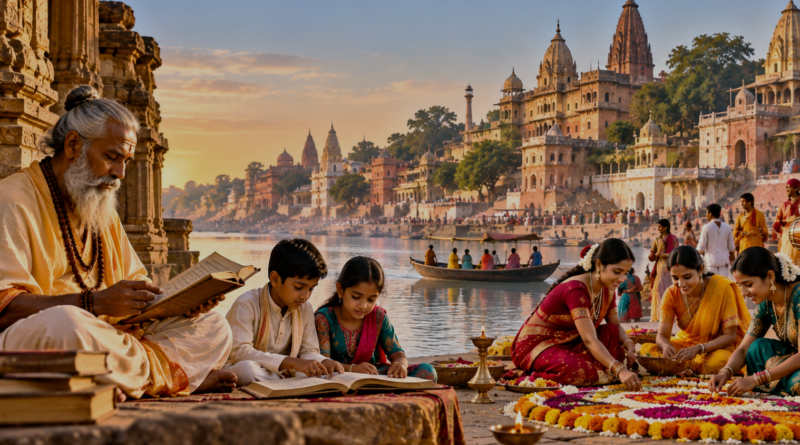
How Indian Culture Has Evolved Over Thousands of Years – India Times Group
From ancient civilizations and spiritual traditions to modern lifestyles, Indian culture reflects a remarkable journey of adaptation, diversity, and continuity.
Introduction
Indian culture is one of the oldest and most diverse cultural traditions in the world. Over thousands of years, it has developed through the rise and fall of civilizations, the emergence of religions, the growth of kingdoms, foreign interactions, social movements, and technological advancements. Despite these changes, India has preserved many of its traditional values, artistic expressions, festivals, and philosophical ideas. This ability to embrace new influences while maintaining connections with the past has made Indian culture distinctive.
Culture in India is not limited to clothing, food, festivals, or religious practices. It also includes languages, literature, family relationships, architecture, music, dance, social customs, moral principles, and ways of understanding life. Each generation has contributed something new to this cultural landscape, creating a continuous process of transformation.
From the earliest settlements along river valleys to the rapidly changing cities of the twenty-first century, Indian culture has never remained completely static. It has evolved through interaction, creativity, conflict, cooperation, and the exchange of ideas. Understanding this journey provides valuable insight into the identity of modern India and the traditions that continue to shape its society.
1. The Foundations of Ancient Indian Civilization
The story of Indian culture begins with early human settlements, agricultural communities, and the development of organized societies. As people learned to cultivate crops, domesticate animals, and establish permanent homes, they developed social customs, religious beliefs, artistic practices, and systems of cooperation.
One of the most important milestones was the emergence of the Indus Valley Civilization, which flourished several thousand years ago. Its major urban centres, including Harappa and Mohenjo-daro, demonstrated impressive planning, drainage systems, standardized construction methods, and organized commercial activity.
These cities reveal that early inhabitants possessed sophisticated knowledge of architecture, craftsmanship, trade, and community organization. Artifacts such as pottery, ornaments, seals, and figurines provide clues about their everyday lives and artistic preferences.
Trade connected these communities with distant regions, allowing goods, techniques, and ideas to travel across geographical boundaries. Such exchanges established an early pattern that would continue throughout Indian history.
Although many aspects of Indus Valley religious beliefs and social organization remain uncertain, the civilization represents an important foundation in the long development of life in the Indian subcontinent. It demonstrates that cultural growth in India began with complex communities capable of innovation and adaptation.
2. The Vedic Age and the Development of Philosophical Thought
Following the decline of the major Indus Valley urban centres, different communities and cultural traditions continued to develop across the subcontinent. The Vedic period became particularly influential in shaping religious practices, philosophical discussions, social customs, and literary traditions.
The Vedas preserved hymns, rituals, and ideas that became central to several later Hindu traditions. Oral transmission played a significant role in preserving these texts, demonstrating the importance of memory, disciplined learning, and teacher-student relationships.
Over time, philosophical inquiry expanded beyond ritual practices. Thinkers explored questions concerning existence, consciousness, morality, knowledge, and the relationship between human beings and the universe. The Upanishads became important expressions of this intellectual development.
Indian philosophy did not evolve through a single school of thought. Different traditions debated fundamental questions and proposed contrasting explanations of reality and human experience.
The growth of Buddhism and Jainism introduced additional perspectives on ethical conduct, non-violence, self-discipline, and liberation. These traditions challenged established assumptions and contributed to broader discussions about the nature of suffering, responsibility, and spiritual development.
This period established a lasting characteristic of Indian culture: the coexistence of diverse philosophical approaches and the continuing search for meaning through reflection and debate.
3. The Growth of Kingdoms, Literature, and Classical Arts
As political institutions developed, powerful kingdoms and empires helped shape Indian cultural life. Royal courts, religious institutions, educational centres, and prosperous towns became important places for artistic and intellectual activity.
The Maurya Empire contributed to political integration and the spread of ideas across extensive territories. Emperor Ashoka’s support for Buddhist teachings helped carry Indian philosophical traditions beyond the subcontinent. His inscriptions also provide evidence of efforts to communicate ethical principles and administrative messages to diverse populations.
Later periods witnessed significant developments in literature, mathematics, astronomy, sculpture, painting, and architecture. Sanskrit literature flourished, while regional languages gradually developed rich literary traditions of their own.
Classical works of drama and poetry explored love, duty, nature, political life, and human emotions. Epics such as the Ramayana and the Mahabharata became deeply influential through their many regional retellings, performances, and interpretations.
Artistic traditions also became more sophisticated. Temple architecture developed distinctive regional styles, while sculpture depicted religious figures, mythological narratives, and aspects of everyday life.
Music and dance evolved through interactions among local communities, religious institutions, royal patrons, and travelling performers. These forms were not merely entertainment; they also served educational, devotional, ceremonial, and storytelling purposes.
The classical period helped establish artistic and intellectual traditions that later generations continued to reinterpret.
4. Regional Diversity and the Formation of Local Identities
India’s geography played an important role in the development of its culture. Mountains, rivers, forests, deserts, coastlines, and fertile plains created different ways of living and encouraged the growth of distinctive regional communities.
As societies developed in different parts of the subcontinent, languages, cuisines, clothing styles, festivals, and artistic traditions became increasingly diverse.
Tamil literature, for example, preserved early expressions of love, warfare, landscapes, and social relationships. Other regions developed their own literary traditions in languages such as Kannada, Telugu, Bengali, Marathi, and later Hindi and several other modern Indian languages.
Religious architecture also reflected regional differences. Temples in southern India developed distinctive towering gateways and elaborate sculptural programmes, while northern and central regions produced their own characteristic architectural forms.
Local agricultural practices influenced festivals, seasonal celebrations, and food habits. Coastal communities developed culinary traditions connected with fishing and maritime trade, while mountain communities adapted their clothing, housing, and diets to colder environments and difficult terrain.
These differences did not prevent cultural interaction. Pilgrimage routes, trade networks, travelling scholars, and migrating communities carried stories, artistic techniques, and beliefs across regions.
Consequently, Indian culture developed not as a uniform system but as a collection of interconnected traditions, each contributing to a broader cultural identity.
5. The Influence of Islam and the Medieval Cultural Synthesis
The medieval period introduced further transformations through trade, migration, political changes, and the establishment of new kingdoms. Islamic traditions reached India through multiple routes, including maritime commerce and overland connections.
Over time, interactions between Indian and Persianate cultural worlds influenced architecture, literature, music, administration, clothing, and cuisine. These exchanges were complex and varied across regions and historical periods.
Indo-Islamic architecture combined different building techniques and artistic preferences. Mosques, tombs, gardens, forts, and palaces displayed distinctive arrangements of arches, domes, geometric patterns, calligraphy, and decorative stonework.
The Mughal period produced notable architectural achievements, including monumental gardens, intricately decorated buildings, and grand structures that reflected both regional craftsmanship and international influences.
Culinary traditions also changed as ingredients, cooking methods, and dishes travelled between communities. Rice preparations, breads, rich gravies, aromatic spices, and elaborate festive meals developed in different forms according to local tastes and resources.
Language evolved through contact as well. Persian influenced administration and literary culture, while interactions among Persian, Arabic, Turkic, and Indian linguistic traditions contributed to the development of Hindustani and related literary expressions.
However, cultural exchange did not mean that every community adopted the same customs. Religious differences, political rivalries, and social divisions remained significant. The period is best understood as one of both cultural creativity and historical complexity.
6. The Bhakti and Sufi Movements
Among the most influential developments in Indian cultural history were the Bhakti and Sufi traditions. Although they emerged from different religious backgrounds, both included influential teachers who emphasized devotion, spiritual experience, and the importance of inner transformation.
Bhakti poets and saints expressed religious ideas through regional languages, songs, poems, and public performances. Figures such as Kabir, Mirabai, Tulsidas, and several South Indian devotional poets reached audiences far beyond elite literary circles.
Their works addressed themes such as love, humility, devotion, social behaviour, and the relationship between individuals and the divine. Some challenged rigid social hierarchies and questioned religious practices that placed excessive importance on outward rituals.
Sufi traditions, meanwhile, developed influential networks centred on spiritual guidance, ethical conduct, poetry, and devotional music. Sufi teachers and institutions became important in many regions, attracting followers from different social backgrounds.
These movements helped expand the role of vernacular languages in religious and literary expression. Their songs and teachings remain influential in Indian music, storytelling, spiritual practice, and popular culture.
Their lasting contribution lies partly in making complex spiritual ideas accessible through familiar language and shared human experiences.
7. Colonial Rule and the Transformation of Society
British colonial rule brought major changes to Indian political institutions, education, economic relationships, communication, and social life. These changes were neither uniform nor entirely beneficial, and many occurred within an unequal system designed to serve colonial interests.
Railways, printing presses, postal networks, and modern communication systems changed how people travelled, exchanged information, and organized commercial activities. Print culture also helped newspapers, books, pamphlets, and political ideas reach expanding audiences.
English-language education introduced many Indians to new intellectual traditions, including modern scientific thought, constitutional ideas, and political debates. At the same time, Indian languages and traditional systems of learning continued to influence cultural life.
Colonial economic policies disrupted many existing industries and livelihoods. Traditional artisans faced new competition, while changing land arrangements and commercial agriculture affected rural communities.
The nineteenth and early twentieth centuries also witnessed important social reform movements. Reformers debated education, caste discrimination, women’s rights, religious practices, and the need to challenge harmful customs.
Women increasingly participated in education, public discussion, and social activism, although substantial barriers remained.
The independence movement eventually became a powerful cultural force. Nationalist writers, artists, educators, and political leaders used songs, literature, symbols, and public gatherings to encourage collective identity and resistance to colonial rule.
Colonialism therefore transformed Indian culture while also provoking renewed interest in indigenous traditions, languages, and historical achievements.
8. Independence and the Creation of Modern India
India’s independence in 1947 marked a major turning point. The country inherited enormous cultural diversity alongside the painful consequences of Partition, including displacement, violence, and lasting social trauma.
The adoption of the Constitution established a democratic framework that recognized fundamental rights and sought to protect equality, religious freedom, and cultural diversity.
Independent India faced the challenge of building a shared national identity without eliminating regional and linguistic differences. The reorganization of states along linguistic lines reflected the importance of language in regional identity.
Public education, universities, scientific institutions, broadcasting, and national cultural organizations expanded opportunities for learning and artistic expression.
Cinema became particularly influential. Hindi films and regional film industries provided entertainment while reflecting changing family relationships, social expectations, political concerns, and popular aspirations.
Radio, television, and later digital communication allowed cultural expressions to reach audiences across greater distances. Folk music, classical performances, regional cinema, and contemporary entertainment all contributed to changing ideas about modern Indian identity.
Economic development and urbanization also altered family structures, employment patterns, and lifestyles. Yet festivals, religious gatherings, weddings, and community celebrations continued to connect people with their cultural roots.
Modern Indian identity gradually developed through the interaction of democratic institutions, regional pride, national belonging, and inherited traditions.
9. Food, Clothing, Festivals, and Everyday Cultural Change
Everyday life provides some of the clearest examples of how Indian culture evolves. Food, clothing, festivals, and family customs have changed continuously through migration, trade, technology, and changing social needs.
Indian cuisine reflects centuries of agricultural development and cultural contact. Rice, wheat, lentils, vegetables, spices, dairy products, and regional ingredients form the basis of many traditional diets. New ingredients and cooking techniques introduced through trade and migration expanded this variety.
Today, regional dishes coexist with international cuisines, restaurant culture, packaged foods, and changing dietary preferences. Traditional recipes are frequently adapted to suit modern schedules while retaining familiar flavours.
Clothing has followed a similar path. Sarees, salwar kameez, dhotis, turbans, and other traditional garments remain important in many settings, while jeans, shirts, suits, and contemporary fashion have become common in everyday life.
Many people combine traditional and modern clothing according to personal preference, profession, region, and occasion.
Festivals also demonstrate cultural continuity and change. Diwali, Holi, Eid, Christmas, Gurpurab, Pongal, Baisakhi, Onam, and numerous regional celebrations bring communities together in different ways.
Celebration methods have changed with urban living, electronic payments, online shopping, environmental awareness, and digital communication. Nevertheless, many festivals continue to emphasize family relationships, generosity, gratitude, community participation, and shared memories.
10. Indian Culture in the Digital Age
The twenty-first century has introduced new forces that are reshaping Indian cultural life. Smartphones, social media, streaming platforms, online education, and digital communication have changed how people consume entertainment, learn languages, maintain relationships, and share traditions.
A folk song recorded in a village can now reach an international audience. Regional films can attract viewers across India, while classical musicians can teach students through online platforms.
Digital tools also help preserve manuscripts, historical photographs, endangered languages, traditional crafts, and oral histories. Younger generations can explore cultural knowledge that might otherwise remain difficult to access.
At the same time, globalization has introduced new challenges. International fashion, entertainment, consumer habits, and online trends influence aspirations, particularly among younger people. Traditional practices may lose visibility when communities move away from ancestral occupations or when local languages receive less attention.
Digital misinformation and simplified representations of history can also create misunderstandings about India’s complex past.
The challenge is not to reject modern technology but to use it thoughtfully. Cultural preservation requires education, responsible documentation, support for traditional artists, and respect for the many communities that contribute to India’s heritage.
Cultural traditions remain strongest when people understand their meaning rather than simply repeating their outward forms.
11. The Future of Indian Cultural Identity
The future of Indian culture will depend on how effectively the country balances continuity with change. Economic development, urbanization, migration, scientific progress, and international cooperation will continue to influence social values and everyday habits.
Traditional crafts and performing arts need opportunities to reach new audiences and provide sustainable livelihoods. Regional languages require support through education, publishing, digital content, and cultural programmes.
Historical monuments and archaeological sites also deserve careful preservation. Protecting physical heritage is important, but intangible heritage—including songs, storytelling, culinary knowledge, rituals, and local skills—requires equal attention.
Young Indians have an important role in this process. They can explore their cultural inheritance while questioning practices that promote discrimination or restrict individual freedom. Respecting tradition does not require accepting every historical custom without examination.
A living culture must allow discussion, creativity, and reform. India’s cultural strength has often come from its ability to accommodate different ideas, although achieving genuine equality and mutual understanding remains an ongoing task.
The goal should be to preserve cultural knowledge while ensuring that future generations can participate in shaping it.
Conclusion
The evolution of Indian culture over thousands of years is a story of continuity, diversity, and transformation. From the urban settlements of the Indus Valley Civilization to the philosophical traditions of ancient India, from medieval artistic exchanges to colonial-era reform movements and the digital revolution, every period has contributed to the country’s cultural character.
Indian culture has never been the product of a single community, language, religion, or historical moment. It has developed through countless interactions among people with different experiences, beliefs, and aspirations.
Its languages, music, architecture, cuisine, literature, festivals, and philosophical traditions reveal a society that has repeatedly adapted to new circumstances while preserving meaningful connections with its past.
The most important lesson from this long journey is that culture is not a fixed inheritance. It is a living process, shaped by the choices people make every day. By preserving historical knowledge, respecting diversity, encouraging creativity, and addressing social inequalities, India can protect its cultural heritage while allowing it to grow.
Ultimately, the enduring strength of Indian culture lies not simply in its ancient origins but in its continuing ability to inspire, adapt, and connect generations across time.