
The History of Folk Art in India – India Times Group
Introduction
India’s cultural heritage is a remarkable collection of traditions, beliefs, stories, and artistic expressions developed over thousands of years. Among its most distinctive features is folk art, a form of creativity that reflects the everyday lives, spiritual beliefs, festivals, occupations, and social experiences of ordinary people. Unlike art created primarily for royal courts or elite institutions, folk art has traditionally flourished in villages, tribal communities, households, and local cultural gatherings. It has been passed from one generation to another through observation, practice, storytelling, and community participation.
The history of Indian folk art is closely connected with the country’s geographical diversity and cultural development. Different regions developed their own painting styles, embroidery techniques, pottery designs, wall decorations, and handmade crafts using locally available materials. These artistic traditions often served practical purposes while also expressing religious devotion, celebrating seasonal changes, preserving community memories, and communicating ideas about nature and society.
From the geometric patterns of tribal paintings to the colourful narratives of village murals, Indian folk art demonstrates how creativity can emerge from everyday experiences. Although modern technology and changing lifestyles have transformed many traditional practices, folk art continues to play an important role in India’s cultural identity. Understanding its history helps us appreciate the knowledge, imagination, and craftsmanship that have shaped these enduring artistic traditions.
1. The Ancient Origins of Indian Folk Art
The origins of folk art in India can be traced to early human communities that expressed their experiences through drawings, symbols, decorative objects, and handmade tools. Prehistoric rock paintings found in different parts of the subcontinent provide evidence of early artistic activity. These paintings depict animals, hunting scenes, human figures, and group activities, offering glimpses into the lives and surroundings of ancient communities.
The rock shelters of Bhimbetka in Madhya Pradesh are particularly important examples of this early artistic heritage. Their paintings represent different periods of human activity and demonstrate how visual expression developed alongside changes in society and the environment.
Early artistic practices were closely connected with survival, communication, and collective experience. People observed animals, landscapes, weather, and human behaviour, translating these observations into visual forms. Although the precise meanings of many ancient images remain uncertain, they reveal a longstanding human desire to record experiences and express ideas through art.
As settled communities developed agriculture and permanent homes, decorative practices gradually became part of domestic and ceremonial life. People began using natural pigments, clay, fibres, wood, and other locally available materials to create objects for practical and symbolic purposes.
These early traditions established foundations for later forms of community-based artistic expression. However, Indian folk art did not emerge from a single source; it developed through numerous local traditions that evolved independently and interacted over time.
2. Folk Art and the Growth of Village Communities
As villages and agricultural societies expanded, folk art became increasingly connected with household activities, seasonal celebrations, and community rituals. Artistic expression was often integrated into daily routines rather than treated as a separate profession.
Women in many communities decorated floors, walls, courtyards, and entrances using rice paste, coloured powders, natural pigments, and other available materials. These designs could welcome visitors, mark weddings, celebrate harvests, or accompany religious occasions.
Patterns frequently included flowers, leaves, birds, animals, circles, triangles, and other geometric forms. Their meanings varied according to regional beliefs and customs. Some designs symbolized prosperity or protection, while others represented fertility, harmony, or a connection with nature.
In agricultural communities, artistic practices often followed the rhythm of the seasons. Harvest celebrations, the arrival of monsoon rains, and important family ceremonies created opportunities for collective creativity.
Local materials played a major role in determining artistic styles. Communities surrounded by forests might develop traditions involving wood, bamboo, leaves, and natural fibres, while other regions became known for clay work, textile decoration, or painted surfaces.
Folk art therefore reflected the relationship between people and their environment. It also strengthened community identity because familiar designs and techniques communicated shared memories and cultural values.
3. The Development of Regional Folk Painting Traditions
Over centuries, different regions of India developed distinctive painting traditions. These styles reflected local environments, religious stories, social customs, and available materials.
Some of India’s best-known folk and community painting traditions include:
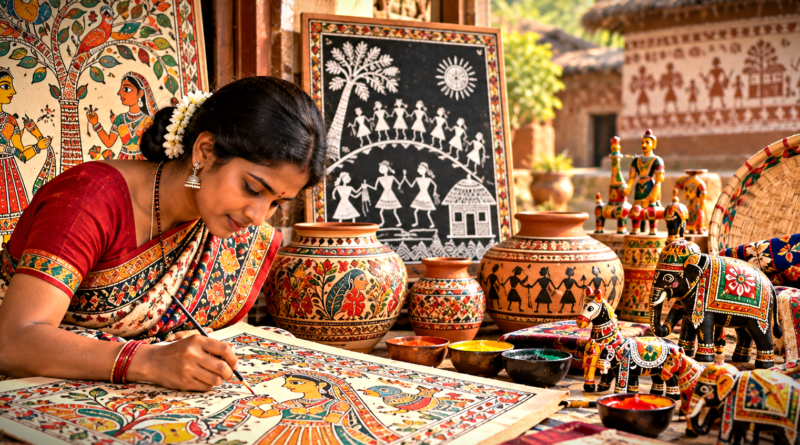
– Madhubani painting: Originating in the Mithila region of Bihar, this tradition is known for densely filled compositions, bold outlines, and images of plants, animals, deities, and ceremonial themes. It was traditionally practised on walls and floors before becoming widely produced on paper and other surfaces.
– Warli painting: Associated with tribal communities in Maharashtra, Warli art uses simple geometric shapes to depict farming, dancing, hunting, village life, and relationships between people and nature.
– Pattachitra: Practised in Odisha and parts of West Bengal, Pattachitra is known for detailed lines, decorative borders, and narrative imagery. Many traditional works portray religious stories and mythological figures.
– Gond art: Associated with Gond communities in central India, this tradition often features animals, trees, birds, and other elements of nature rendered through distinctive lines, dots, and patterned surfaces.
– Phad painting: Traditionally associated with Rajasthan, Phad paintings present elaborate narrative scenes, often depicting regional heroes and devotional stories on long painted cloths.
These traditions differ in technique and subject matter, but they share an important characteristic: each reflects the cultural knowledge and artistic practices of particular communities. Their development also demonstrates that India’s artistic history extends far beyond the styles associated with palaces, temples, and formal institutions.
4. The Influence of Religion, Myths, and Folklore
Religion and storytelling have played major roles in the development of Indian folk art. Communities have used paintings, sculptures, textiles, and decorative objects to represent deities, narrate legends, and preserve stories that might otherwise be transmitted mainly through oral traditions.
Hindu epics, regional legends, local deities, and devotional practices appear in many folk art forms. Religious festivals often provide opportunities for artists to create temporary decorations, painted images, ceremonial objects, and elaborate displays.
In Odisha, traditional Pattachitra works frequently portray episodes connected with Lord Jagannath and other religious narratives. In Rajasthan, Phad paintings have historically been associated with performances in which storytellers use painted cloths to narrate the deeds of revered figures.
Other communities express their spiritual relationships through images of ancestors, protective spirits, animals, forests, and natural forces. These traditions may not fit neatly into the categories used for formal religious art because their meanings are rooted in specific community practices.
Folk art has also preserved local variations of familiar stories. Different regions may portray the same mythological character through different clothing, colours, landscapes, and visual conventions.
Through these artistic expressions, communities have transmitted beliefs and cultural memories across generations. Folk art has consequently served as both a visual language and a means of preserving intangible heritage.
5. Folk Art During Medieval India
During medieval times, Indian society experienced significant changes through expanding trade networks, political developments, religious movements, and cultural exchanges. Folk art continued to develop within local communities, often adapting to changing social and economic conditions.
Regional rulers and religious institutions sometimes supported craftspeople, while markets created opportunities for artisans to sell pottery, textiles, toys, decorative objects, and paintings. Artistic techniques could travel between neighbouring regions through trade, migration, pilgrimage, and the movement of skilled workers.
The relationship between folk traditions and courtly art was complex. Some decorative patterns and craft techniques circulated across social settings, while community-based traditions retained distinctive materials, subjects, and methods.
Textile production became particularly important in many regions. Embroidery, weaving, printing, and dyeing developed into sophisticated practices that reflected local identities and commercial connections. Different communities produced distinctive motifs, with designs influenced by regional landscapes, beliefs, and available resources.
Traditional pottery also remained central to domestic and ceremonial life. Clay vessels, lamps, figurines, and decorative objects were used in households, markets, and festivals.
Despite changing political circumstances, folk art continued to evolve through community participation. Its survival depended not only on wealthy patrons but also on families, local practitioners, and the continuing demand for handmade objects.
6. Folk Art Under British Colonial Rule
British colonial rule brought major economic, political, and social changes that affected Indian folk art. Industrial manufacturing, changing trade relationships, and the growth of new markets altered the livelihoods of many traditional artisans.
Machine-produced goods competed with handmade products, placing pressure on some craft communities. Certain traditional occupations declined as production methods and consumer preferences changed. At the same time, collectors, museums, exhibitions, and commercial markets began documenting or promoting selected forms of Indian art.
These developments created both opportunities and difficulties. Some artists found new customers for their work, while others had to modify their techniques, materials, or subjects to meet changing demand.
Colonial-era classifications sometimes treated community-based art as an unchanging survival from the past. Such views overlooked the creativity and adaptability of the artists themselves. Folk traditions were never completely static; they changed in response to new materials, economic needs, and cultural interactions.
The period also encouraged broader discussions about Indian cultural identity. Artists, scholars, and cultural organizations increasingly considered the importance of preserving regional crafts and indigenous knowledge.
Although colonial economic changes disrupted many established practices, numerous folk art traditions survived because communities continued to use them in rituals, household decoration, local celebrations, and everyday production.
7. Folk Art After Indian Independence
After India gained independence in 1947, preserving the country’s cultural heritage became an important part of national cultural development. Government institutions, museums, cultural organizations, and educational programmes began supporting various traditional art forms.
Folk art received greater visibility through exhibitions, craft fairs, training initiatives, and efforts to connect artists with wider markets. Some painters who had traditionally worked on household walls began transferring their designs onto paper, canvas, and other portable surfaces.
This transition allowed traditional artists to reach customers beyond their home communities. Madhubani painting, for example, gained broader recognition as artists adapted established motifs to new formats. Similar changes occurred in other regional traditions.
However, moving from ritual or domestic settings into commercial production also changed the role of certain artworks. Designs once created for specific ceremonies could become decorative products purchased by people unfamiliar with their original meanings.
The growing market created opportunities for income and recognition, but it also raised questions about authenticity, fair compensation, and cultural ownership.
Independent India has therefore witnessed both preservation and transformation. Folk art has become more visible nationally and internationally, while many practitioners continue to negotiate the relationship between inherited traditions and modern economic realities.
8. The Role of Women and Tribal Communities
Women and tribal communities have made essential contributions to the development and continuation of Indian folk art. In many regions, artistic knowledge has traditionally been transmitted within families, with children learning by watching older relatives prepare materials, create patterns, and participate in ceremonies.
Women have played important roles in floor decorations, wall paintings, embroidery, weaving, basketry, and numerous household crafts. These activities often combine artistic expression with social responsibilities and cultural traditions.
Tribal artists have also preserved distinctive visual languages rooted in their relationships with forests, animals, ancestral histories, and community beliefs. Their artworks may express environmental knowledge and cultural perspectives that differ from those represented in mainstream artistic institutions.
Increasing recognition has enabled many artists to participate in exhibitions, workshops, and commercial opportunities. Some have become respected practitioners who teach younger generations and introduce traditional methods to new audiences.
Nevertheless, recognition does not always translate into fair earnings. Intermediaries may receive substantial profits while artists struggle to secure appropriate payment or recognition for their work.
Supporting women and tribal artists requires more than displaying their creations. It also involves protecting their intellectual and cultural rights, ensuring fair market access, and respecting the communities from which their traditions originate.
9. Folk Art in the Modern Digital Age
Technology has created new possibilities for Indian folk artists. Social media, online marketplaces, digital exhibitions, and virtual workshops allow creators to display their work to audiences across geographical boundaries.
Artists can communicate directly with buyers, explain the stories behind their designs, and develop new opportunities for selling paintings, textiles, and handmade products. Digital documentation can also help preserve information about traditional techniques, materials, and community histories.
Modern designers increasingly draw inspiration from folk motifs for clothing, home decoration, illustrations, packaging, and public art. These collaborations can introduce traditional artistic styles to younger generations and create additional sources of income.
However, digital exposure also presents challenges. Designs can be copied without permission, traditional knowledge can be used without proper acknowledgment, and mass-produced imitations can compete with handmade work.
Some artists may also lack reliable internet access, digital skills, or the resources required to market their products effectively.
Responsible promotion should therefore prioritize artist recognition, fair compensation, and accurate representation of cultural traditions. Technology is most useful when it supports the people who sustain these art forms rather than simply extracting commercial value from their work.
10. Preserving India’s Folk Art for Future Generations
The survival of Indian folk art depends on continued practice, education, and community support. Although many traditions remain active, some face declining participation because younger generations pursue different occupations or move away from their ancestral communities.
Rising material costs, limited market access, and competition from inexpensive manufactured products can also make traditional crafts difficult to sustain.
Schools and cultural institutions can help address these challenges by introducing students to regional artistic traditions through practical workshops, exhibitions, and interactions with practising artists.
Local festivals and craft fairs provide opportunities for communities to display their work and explain its cultural significance. Museums can contribute by documenting artistic techniques while presenting the voices and experiences of the people who created them.
Supporting traditional artists through fair purchasing practices is equally important. Consumers can learn about an artwork’s origin, purchase directly from practitioners when possible, and avoid products falsely marketed as handmade or culturally authentic.
Preservation should not require artists to reproduce historical designs without change. Living traditions naturally evolve. The goal is to ensure that artists have the freedom and resources to continue practising their art while retaining meaningful connections with their cultural heritage.
Conclusion
The history of folk art in India reflects the creativity, resilience, and cultural diversity of communities across the subcontinent. From prehistoric rock paintings to contemporary tribal illustrations, embroidered textiles, ceremonial decorations, and regional painting traditions, folk art has recorded the experiences and beliefs of generations.
Its development has been influenced by agriculture, religion, storytelling, trade, political change, colonialism, and modern technology. Throughout these transformations, local artists have adapted materials and techniques while preserving distinctive cultural identities.
Folk art is much more than decoration. It is a form of historical memory, a source of livelihood, and a means through which communities communicate their relationships with nature, spirituality, and society.
Protecting this heritage requires recognizing the artists who sustain it, supporting their economic independence, and encouraging younger generations to learn traditional skills. It also requires respecting the cultural contexts in which particular designs and practices originated.
As India continues to modernize, its folk art traditions remain valuable reminders that cultural progress does not require abandoning the past. By encouraging creativity while safeguarding traditional knowledge, India can ensure that its diverse folk art heritage continues to inspire future generations.