
The Role of Agriculture in Generating Rural Employment – India Times Group
Introduction
Agriculture has long been the foundation of rural life. In many countries, especially in developing economies, farming provides more than food: it creates jobs, supports local businesses, preserves traditional skills, and keeps rural communities connected to wider local markets. Its contribution to employment extends far beyond the person working in a field. It includes people who supply seeds, operate machinery, transport crops, process food, sell produce, and provide services to farmers.
Rural employment remains an important development challenge. When people cannot find reliable work near home, they may be forced to migrate to cities, leaving families and communities under pressure. A productive and diverse agricultural economy can create local opportunities, improve incomes, and help rural areas become more resilient. However, agriculture cannot generate secure employment simply by increasing production. It must become more efficient, better connected to markets, and capable of offering decent work throughout the year.
Agriculture as a Major Source of Rural Livelihoods
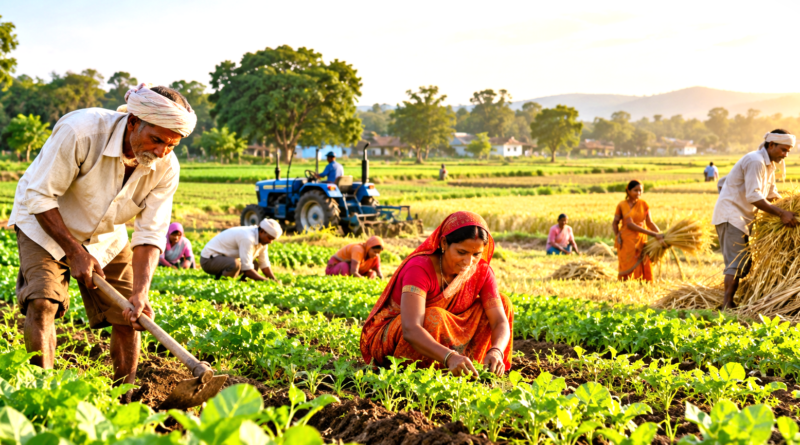
Farming directly employs cultivators, agricultural labourers, livestock keepers, horticulturists, fishers, and people engaged in other related activities. Land preparation, sowing, irrigation, weeding, harvesting, and storage all require labour, although the amount of work depends on crop choice, farm size, weather, and mechanisation.
Small and marginal farms are especially important to rural employment because they often rely on family labour and hire workers during busy periods. In areas where large-scale industry is limited, farming can provide an accessible source of livelihood for people with different levels of formal education. It also supports household activities such as maintaining animals, growing vegetables, and producing food for local use.
Employment Beyond Cultivation
The employment impact of agriculture reaches across an extensive value chain. Before planting begins, workers are needed to produce and distribute seeds, fertilisers, tools, irrigation equipment, and other inputs. During cultivation, farms may employ labourers, machinery operators, repair workers, and irrigation technicians. After harvest, crops require sorting, grading, cleaning, packing, storage, transportation, processing, and marketing.
Food processing is particularly valuable because it can turn perishable crops into products that last longer and command different prices. Flour mills, dairy units, oil extraction facilities, fruit-processing centres, and local food enterprises can provide work close to farming communities. If such businesses are located near production areas, they may reduce transport losses and allow more of the value generated by crops to remain in rural economies.
Allied Activities Create Diverse Opportunities
Agriculture is closely linked with livestock rearing, dairy farming, poultry, fisheries, beekeeping, and horticulture. These activities can broaden rural employment and reduce dependence on a single crop. A household that grows cereals may also keep dairy animals, cultivate seasonal vegetables, or raise poultry. The combination can create several income sources and make families less vulnerable when one activity performs poorly.
Dairy production creates work in animal care, fodder cultivation, milking, collection, chilling, transport, and processing. Poultry and fisheries require skills in feeding, disease prevention, production management, and distribution. Beekeeping can support honey production while contributing to pollination, and horticulture can create jobs in nurseries, orchard management, harvesting, and packaging.
Opportunities for Women and Young People
Women contribute substantially to rural agriculture, from sowing and harvesting to livestock care, seed selection, food preservation, and family farm management. However, their work may be unpaid or under-recognised, and women often face barriers to land ownership, credit, equipment, training, and leadership roles.
Recognising women as agricultural workers and entrepreneurs can improve the fairness and productivity of rural economies. Access to self-help groups, producer organisations, suitable tools, financial services, and market information can help women build businesses in dairy, food processing, seed production, tailoring for agricultural needs, and direct marketing. Safe working conditions and a fair share of earnings are equally important.
Young people can bring new skills and ideas to agriculture. They may work in precision farming, soil testing, equipment maintenance, digital market services, nursery management, food processing, or agricultural advisory services. To attract them, farming must be seen as a field with opportunities for learning, innovation, and business growth—not merely as work inherited from previous generations. Practical training, mentorship, access to finance, and links with buyers can help young entrepreneurs establish viable rural enterprises.
Technology and the Changing Nature of Farm Work
Technology changes the kinds of jobs agriculture creates. Mechanisation can reduce physically demanding tasks and help farmers complete time-sensitive operations, particularly where labour is scarce. At the same time, it can reduce demand for some forms of manual work.
Tractors, harvesters, irrigation systems, drones, and soil-monitoring tools require operators, mechanics, technicians, and service providers. Small farmers may be able to access machinery through rental centres or shared-service businesses rather than purchasing expensive equipment themselves. This model can create local employment while making modern tools more accessible.
Digital platforms can help farmers compare prices, obtain weather information, arrange transport, and connect with buyers. However, technology delivers benefits only when people can use it confidently and services are reliable. Training, affordable connectivity, local-language information, and support for people with limited digital skills are essential. Technology should complement rural workers and open pathways to better jobs wherever possible.
Agricultural Infrastructure and Rural Enterprise
Reliable infrastructure is central to employment generation. Poor roads, limited electricity, inadequate irrigation, and a lack of storage can prevent farmers from expanding production or reaching profitable markets. Crops may spoil before sale, and processing businesses may be unable to operate consistently. Investment in rural roads, cold storage, warehouses, reliable power, irrigation, and market facilities can address these barriers.
Storage and processing are especially important for reducing losses and extending the period in which produce can be sold. Cold chains can support dairy, fish, flowers, fruit, and vegetables, while warehouses help farmers manage the timing of sales. These facilities also create jobs in construction, maintenance, quality control, packaging, logistics, and administration.
Local entrepreneurship can add further value. Rural businesses may produce pickles, jams, flour, spices, dairy products, natural fibres, or other goods based on local crops. Business development support, food safety knowledge, suitable packaging, and dependable market access can help such enterprises grow. When rural producers cooperate through collectives or producer organisations, they may be better placed to purchase inputs, negotiate prices, and reach larger buyers.
Challenges That Limit Employment
Despite its potential, agriculture faces serious obstacles. Unpredictable rainfall, droughts, floods, heat, pests, and plant diseases can damage crops and reduce demand for labour. Small landholdings may limit economies of scale, while high input costs and uncertain prices can make farm income unstable. Inadequate storage and weak transport links may force farmers to sell quickly, even when prices are low.
These challenges require coordinated solutions. Better access to affordable credit and crop insurance can help manage risk. Extension services can share practical knowledge about soil health, water conservation, pest management, and climate-resilient practices. Transparent market information, stronger farmer organisations, and more dependable purchasing arrangements can improve bargaining power. Employment programmes and skill-development initiatives can provide support during periods when farm work is limited.
Sustainable Agriculture and Long-Term Jobs
Employment growth should not come at the cost of degrading the land and water on which future livelihoods depend. Excessive use of water, soil erosion, declining soil fertility, and careless chemical application can weaken agricultural productivity over time. Sustainable methods can protect natural resources while creating work in composting, watershed management, tree planting, organic input production, efficient irrigation, and soil restoration.
Practices such as crop rotation, mixed farming, integrated pest management, mulching, and water-saving irrigation may improve resilience when adapted to local conditions. They often require knowledge, planning, and sometimes additional labour, creating opportunities for trained workers and service providers. However, farmers need transition support and access to markets that reward quality and sustainability.
The Role of Government and Community Institutions
Governments can strengthen agricultural employment by investing in irrigation, rural infrastructure, research, extension services, skill training, and market access. Policies should support small farmers and landless workers while encouraging enterprises that create stable, fairly paid jobs. Access to credit, insurance, storage, and reliable price information can help rural households make better decisions and invest with greater confidence.
Cooperatives, self-help groups, farmer-producer organisations, local councils, and community institutions can connect people with training, finance, equipment, and buyers. They can also help workers share knowledge and negotiate collectively. Partnerships among farmers, businesses, educational institutions, and public agencies may encourage local processing and improve the link between training and actual job opportunities.
Conclusion
Agriculture generates rural employment through cultivation, allied activities, processing, transport, storage, marketing, equipment services, and a growing range of technology-based businesses. Its greatest employment potential lies in building a connected rural economy in which farmers and workers can earn from more than one activity and retain a larger share of the value they produce.
Real progress requires more than increasing crop output. Rural communities need infrastructure, skills, fair markets, access to finance, climate resilience, and opportunities for women and young people. Sustainable farming and local enterprise development can help create work that is productive and dignified while protecting the resources on which agriculture depends.
When agriculture is supported as both an economic sector and a foundation for rural enterprise, it can reduce distress-driven migration, strengthen household security, and encourage balanced regional development. Investing in the people who grow, process, move, and sell food is therefore an investment in stronger villages and a more inclusive economy.