
Madhubani Painting: History, Techniques, and Cultural Significance – India Times Group
Introduction
India is home to a remarkable variety of traditional art forms that reflect its history, beliefs, customs, and regional identities. Among these, Madhubani painting holds a special place because of its distinctive patterns, vibrant colours, and deep connection with everyday life. Originating in the Mithila region of Bihar, this traditional art form has evolved from a domestic ritual practice into an internationally recognised expression of Indian folk culture. Its detailed compositions, symbolic imagery, and strong association with women’s creativity make it an important part of India’s artistic heritage.
Madhubani painting, also known as Mithila painting, is more than a decorative art. It communicates stories about Hindu mythology, nature, marriage, fertility, community life, and the relationship between human beings and the natural world. Each painting carries meanings shaped by the artist’s surroundings and cultural experiences. Although traditional methods remain influential, contemporary artists have adapted the art form to new materials, subjects, and audiences.
Understanding Madhubani painting requires exploring its historical origins, distinctive techniques, traditional themes, cultural importance, and transformation in the modern world.
The Historical Origins of Madhubani Painting
Madhubani painting takes its name from the Madhubani district of Bihar, situated within the culturally rich Mithila region. The broader tradition is associated with communities across parts of northern Bihar and the adjoining plains of Nepal. For generations, families in this region have maintained artistic practices connected with religious ceremonies, festivals, household rituals, and important stages of life.
The precise historical beginning of Madhubani painting is difficult to establish because its earliest forms were transmitted primarily through oral traditions and household practices rather than written records. According to a popular local tradition, the art form is associated with the marriage of Lord Rama and Sita, who is believed to have been born in Mithila. Stories describe King Janaka encouraging the decoration of the kingdom to celebrate his daughter’s wedding. Although this account forms an important part of the tradition’s cultural identity, it should be understood as folklore rather than a conclusively documented historical origin.
Historically, women painted the walls and floors of homes using natural pigments, handmade brushes, fingers, and simple tools. These paintings decorated spaces used for worship, marriage ceremonies, and seasonal celebrations. Their purpose was not simply to beautify a house but also to invite prosperity, express devotion, and mark auspicious occasions.
For many years, the art remained closely associated with domestic spaces. Mothers taught daughters the designs, symbols, and techniques they had learned from earlier generations. This process of informal education helped preserve distinctive regional styles while allowing individual families to develop their own artistic characteristics.
A major change occurred during the twentieth century, when Madhubani painting increasingly moved from walls and floors onto paper and other portable surfaces. This transition helped artists sell their work beyond their villages and introduced the tradition to wider audiences. The art gradually became an important source of income and a recognised representation of Bihar’s cultural identity.
Traditional Styles and Their Characteristics
Madhubani painting is not a single uniform style. It includes several approaches shaped by community traditions, materials, and artistic preferences. These styles differ in the density of patterns, the treatment of figures, the use of colours, and the amount of open space within a composition.
Bharni Style
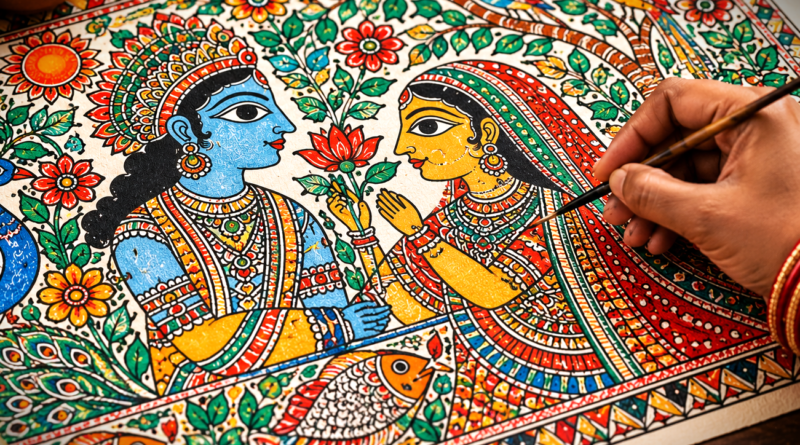
Bharni, meaning filling, is characterised by the extensive use of colour within outlined figures. Artists traditionally depict deities, mythological scenes, and auspicious symbols using vivid shades such as red, yellow, green, blue, and orange.
The figures are often surrounded by flowers, leaves, decorative borders, and geometric patterns. Bharni paintings create a rich visual effect because the composition contains relatively little empty space.
Kachni Style
Kachni is distinguished by delicate lines, fine hatching, and intricate patterns. Rather than relying mainly on large areas of colour, artists build visual depth through closely arranged lines and carefully controlled strokes.
The technique requires patience and precision. Thin lines may be used to represent hair, clothing, feathers, foliage, or ornamental details. The finished painting often appears highly detailed despite its relatively restrained colour palette.
Tantrik Style
Tantrik Madhubani paintings feature sacred symbols, ritual diagrams, and representations of deities associated with particular spiritual traditions. Their compositions may include geometric arrangements and symbolic forms intended to express religious concepts.
These paintings are connected with ritual practices and should be understood within their cultural context rather than simply as decorative designs.
Godna Style
The Godna style draws inspiration from traditional tattooing practices. It commonly uses repeated lines, dots, circles, and geometric arrangements to create rhythmic patterns. Dark outlines and limited colours are characteristic of many examples.
Its visual language demonstrates how artistic ideas can move between different forms of cultural expression, including body decoration, textiles, and painted surfaces.
Kohbar Style
Kohbar painting is traditionally associated with marriage ceremonies. The word refers to a ceremonial space connected with newly married couples in parts of Mithila.
These paintings may feature lotus flowers, bamboo, birds, fish, and other symbols associated with fertility, continuity, prosperity, and family life. Their compositions communicate wishes for a harmonious marriage and the continuation of generations.
Materials and Traditional Painting Techniques
One of the most distinctive features of Madhubani painting is its traditional approach to materials. Historically, artists used resources available in their surroundings, creating pigments and tools from natural substances.
Black pigment could be produced using soot mixed with a binding substance. Yellow might be obtained from turmeric, while red could come from natural mineral or plant-based sources. Green pigments were prepared from suitable leaves, and other colours were derived from locally available materials.
The exact ingredients varied according to local knowledge and the resources accessible to individual artists. Today, many painters use commercially produced colours, acrylic paints, watercolours, and prepared paper to meet changing artistic and market requirements.
The painting process generally begins with an idea or an arrangement of motifs. Artists establish the principal figures and create a composition that balances its central subject with surrounding patterns. Traditionally, the designs were often created without formal preliminary sketches, relying instead on memory, experience, and inherited visual knowledge.
Dark outlines define the figures and separate individual elements. The interiors are filled with colours, parallel lines, dots, crosshatching, or repeated patterns, depending on the style. Artists frequently decorate the background with flowers, leaves, animals, and geometric shapes.
A particularly important characteristic is the tendency to fill the available surface with decorative detail. Empty spaces are often occupied by smaller motifs, producing a dense and visually interconnected composition.
Traditional tools included twigs, sharpened bamboo pieces, fingers, and simple brushes made from natural fibres. Modern painters may use fine commercial brushes and pens, but the emphasis on confident lines and intricate detailing remains central to the art.
Although many Madhubani paintings appear symmetrical, artists do not always follow strict mathematical rules. The balance comes from the arrangement of colours, figures, repeated patterns, and symbolic elements.
Common Themes and Their Symbolic Meanings
Madhubani painting draws inspiration from religion, mythology, nature, social relationships, and daily activities. Its subjects reveal how artistic expression reflects the values and experiences of a community.
Hindu Mythology and Religious Beliefs
Religious subjects have long been important to the tradition. Paintings frequently depict Rama and Sita, Radha and Krishna, Shiva and Parvati, Ganesha, and other deities.
These figures are often presented in highly decorative settings rather than realistic landscapes. Their clothing, surroundings, and accompanying symbols communicate their identities and significance.
Mythological paintings help preserve stories that have been shared across generations. They also connect household worship with visual creativity, allowing religious narratives to become part of everyday surroundings.
Nature and Wildlife
Nature occupies a central position in Madhubani art. Trees, flowers, fish, birds, elephants, peacocks, and other creatures frequently appear in its compositions.
The lotus is commonly associated with purity and auspiciousness, while fish may represent abundance, fertility, and good fortune. Peacocks are often linked with beauty and love, and trees can signify life, continuity, and the interconnectedness of living things.
These interpretations are not universal rules, and meanings may differ according to the artist, occasion, and local tradition. Nevertheless, the repeated presence of natural forms demonstrates the importance of the environment in Mithila’s cultural imagination.
Marriage and Family Life
Marriage-related paintings express hopes for prosperity, companionship, fertility, and family harmony. Kohbar designs are especially significant because their symbols are associated with auspicious beginnings and the continuation of family traditions.
Such paintings also reflect the role of women as creators and custodians of ceremonial knowledge. Through their artwork, women have communicated cultural values and blessings during important family occasions.
Social Life and Contemporary Issues
Modern Madhubani artists increasingly explore subjects beyond mythology and ritual. Their paintings may depict farming, village markets, education, women’s empowerment, environmental conservation, public health, and social change.
This development demonstrates the flexibility of the tradition. While its visual vocabulary remains recognisable, artists can use it to communicate contemporary experiences and concerns.
Madhubani painting is important because it preserves a distinctive regional identity while demonstrating the artistic knowledge of communities that have historically received limited recognition within formal art institutions.
For generations, women played a leading role in maintaining and developing the tradition. Painting provided opportunities for creative expression within household and community settings. Their designs recorded local beliefs, ceremonial practices, family histories, and changing experiences.
The art form also connects generations. When experienced artists teach younger family members how to prepare colours, draw motifs, and arrange compositions, they transmit knowledge that may not be available in written form.
Madhubani painting has also contributed to the cultural visibility of Bihar. Its distinctive designs are now associated with regional identity and appear in exhibitions, cultural festivals, handicrafts, textiles, home furnishings, and contemporary design.
The tradition illustrates how folk art can function simultaneously as a cultural record, a spiritual practice, a means of communication, and a source of livelihood.
Madhubani Painting and Women’s Economic Empowerment
The movement of Madhubani painting onto paper created new economic opportunities for artists, particularly women. Paintings could be sold to buyers outside their immediate communities, enabling traditional skills to generate income.
Cooperatives, self-help groups, exhibitions, handicraft markets, and individual businesses have helped artists reach broader audiences. Some painters have established professional reputations, trained students, and developed independent creative enterprises.
These opportunities can support household incomes and strengthen women’s participation in economic decision-making. They also demonstrate that traditional knowledge can contribute to sustainable livelihoods when artists receive fair payment and access to markets.
However, challenges remain. Artists may struggle with low prices, inconsistent demand, imitation products, limited access to professional training, and the unequal distribution of commercial profits.
Preserving the tradition therefore requires more than promoting its visual appeal. Fair compensation, proper recognition, access to customers, and respect for artists’ creative ownership are equally important.
Global Recognition and Modern Adaptations
Madhubani painting has gradually gained recognition beyond its traditional geographical setting. Exhibitions, cultural exchanges, museums, handicraft fairs, and digital platforms have introduced the art form to international audiences.
Its visual language has also influenced contemporary products and design practices. Madhubani-inspired patterns can be found on clothing, notebooks, household decorations, murals, greeting cards, and accessories.
Artists have experimented with canvas, handmade paper, fabric, and other surfaces. Some combine traditional motifs with modern subjects, while others maintain more conventional compositions.
These adaptations have helped the art reach younger audiences, but they also raise questions about authenticity and commercialisation. Simplified designs may be easier to reproduce on mass-produced goods, yet excessive imitation can weaken the connection between the artwork and the communities that developed it.
A balanced approach allows artists to innovate without abandoning the cultural knowledge that gives the tradition its distinctive character.
Challenges in Preserving the Tradition
Despite its growing popularity, Madhubani painting faces several challenges. Commercial demand can encourage repetitive designs, reducing opportunities for experimentation and individual expression. Cheap imitations may compete with handmade works, making it difficult for artists to earn sustainable incomes.
Another concern is the loss of traditional knowledge. Younger generations may pursue other professions if artistic work offers uncertain financial returns. As a result, techniques involving natural pigments, ritual meanings, and locally specific motifs may gradually become less familiar.
Environmental changes can also affect access to traditional materials. Meanwhile, digital reproduction makes it easier for designs to circulate without proper attribution or compensation.
Preservation efforts should therefore combine practical support with cultural education. Workshops, documentation, artist-led training, responsible tourism, and fair-trade initiatives can help sustain the tradition.
Schools and cultural organisations can introduce students to Madhubani painting as both an artistic practice and a form of regional history. Digital platforms can expand market access when they recognise artists as creators and ensure that their work is appropriately credited.
Conclusion
Madhubani painting represents one of India’s most distinctive folk-art traditions. Rooted in the cultural landscape of Mithila, it brings together mythology, nature, family customs, religious beliefs, and everyday experiences through vibrant colours and intricate patterns.
Its journey from painted household walls to international exhibitions demonstrates the adaptability of traditional art. The development of different styles, the use of symbolic imagery, and the growing participation of artists in contemporary markets reveal a tradition that continues to evolve.
Yet its true significance extends beyond commercial popularity. Madhubani painting preserves generations of artistic knowledge, celebrates women’s creativity, strengthens regional identity, and provides a visual language through which communities express their values and aspirations.
Protecting this heritage requires respect for the artists who sustain it. By supporting fair livelihoods, encouraging younger generations to learn traditional techniques, and promoting responsible innovation, India can ensure that Madhubani painting remains a living art form rather than merely a symbol of the past. Its enduring beauty lies in its ability to honour inherited traditions while giving each new generation the freedom to tell its own stories.