
How Traditional Farming Practices Continue to Shape Indian Agriculture – India Times Group
Introduction
Indian agriculture has developed over thousands of years, shaped by local climates, fertile plains, seasonal rainfall, indigenous knowledge, and the experience of generations of farmers. Even as modern machinery, chemical fertilizers, improved seeds, and digital technologies transform agricultural production, traditional farming practices continue to influence how crops are cultivated across the country. These practices are deeply connected with India’s rural economy, cultural heritage, food security, and environmental sustainability.
Traditional farming is not simply a reminder of the past. It remains a practical source of knowledge for farmers dealing with changing weather conditions, soil degradation, rising cultivation costs, and uncertain market prices. From crop rotation and mixed farming to organic manure, indigenous seed varieties, and traditional water conservation systems, many age-old methods continue to shape agricultural decisions in villages and farming communities.
Although modern agricultural technologies have increased productivity in several regions, traditional knowledge still offers valuable lessons about resource management, biodiversity, and adapting cultivation to local conditions. Understanding its continuing influence helps explain how Indian agriculture can balance productivity with sustainability.
1. The Historical Foundations of Traditional Indian Farming
Agriculture has been central to Indian civilization since ancient times. Early farming communities learned to cultivate crops according to seasonal cycles, soil conditions, and the availability of water. Over generations, farmers developed methods suited to their geographical surroundings, whether they lived in the Himalayan foothills, the Gangetic plains, the Deccan Plateau, or coastal regions.
Traditional farming knowledge was generally passed from parents to children through observation and practical experience. Farmers learned when to prepare fields, which crops performed well in particular soils, how to preserve seeds, and how to respond to changes in rainfall. This knowledge was rarely written down systematically, but it became an important part of community life.
Different regions developed distinctive agricultural systems. Rice cultivation became prominent in areas receiving abundant rainfall, while wheat and other winter crops flourished in suitable northern plains. Millets, pulses, oilseeds, and drought-resistant crops supported farming in drier regions.
These regional differences demonstrate an important principle: successful agriculture depends on understanding local conditions. Traditional practices continue to shape Indian farming because they were developed through long-term interaction between people, land, water, and climate.
2. Indigenous Seeds and the Preservation of Crop Diversity
One of the most significant traditional practices is the preservation and exchange of indigenous seeds. Before commercial seed varieties became widely available, farmers frequently selected seeds from healthy plants after each harvest and stored them for the next growing season.
This selection process allowed farming families to maintain crop varieties suited to their local environments. Certain traditional rice varieties were valued for their aroma or cooking qualities, while some millet and pulse varieties were appreciated for their ability to grow under limited rainfall.
Indigenous seeds also represent an important reservoir of agricultural diversity. Different varieties may possess characteristics such as tolerance to particular environmental conditions, distinctive maturity periods, or resistance to specific pests and diseases. Maintaining this diversity can provide farmers with alternatives when growing conditions change.
In many communities, seed exchange remains a social activity that strengthens cooperation among farmers. Local seed banks and community initiatives also help preserve varieties that might otherwise disappear as cultivation becomes concentrated around a smaller number of commercial crops.
However, traditional seeds are not automatically superior to modern varieties in every situation. Their performance depends on the crop, soil, climate, and farming objective. A balanced approach allows farmers to combine suitable indigenous varieties with improved seeds while preserving valuable genetic diversity.
3. Crop Rotation and Mixed Cropping
Crop rotation is another traditional technique that continues to influence agricultural practices across India. Instead of planting the same crop repeatedly on a field, farmers grow different crops in a planned sequence. A field might support cereals during one season and pulses during another, depending on local conditions.
This approach can improve soil management and interrupt the life cycles of certain pests and diseases. Leguminous crops, including several pulses, can contribute to soil fertility by working with beneficial bacteria that convert atmospheric nitrogen into forms plants can use.
Mixed cropping involves growing two or more crops together in the same field. For example, farmers may cultivate millets alongside pulses or combine suitable cereals with legumes. Such combinations can make better use of available space and provide more than one source of food or income.
These practices also reduce dependence on a single crop. If one crop performs poorly because of irregular rainfall or pest damage, another may still provide a harvest.
In contemporary Indian agriculture, crop rotation and intercropping are increasingly relevant to discussions about sustainable farming. They can help farmers manage risks, diversify production, and reduce unnecessary dependence on chemical inputs. Their success, however, depends on choosing compatible crops and suitable planting arrangements.
4. Organic Manure and Traditional Soil Fertility Management
For generations, Indian farmers have used farmyard manure, compost, crop residues, and other organic materials to maintain soil fertility. Cattle dung, dried leaves, household organic waste, and plant matter were commonly recycled into fields rather than discarded.
These practices reflected an agricultural system in which livestock, crops, and household resources were closely connected. Animal waste returned nutrients to the soil, crop residues supported compost preparation, and agricultural by-products often served several purposes.
Organic materials can improve soil structure, support beneficial soil organisms, and help the ground retain moisture. Composting also provides a useful way to recycle biodegradable waste into agricultural inputs.
Traditional green manuring is another important method. Farmers grow suitable plants and incorporate them into the soil before the main crop is planted. As the plant material decomposes, it contributes organic matter and nutrients.
Today, interest in organic farming and natural resource management has renewed attention to these practices. Nevertheless, organic manure may not supply every crop’s nutritional requirements in sufficient quantities. Its nutrient content varies, and its benefits depend on proper preparation, application, and soil conditions.
Integrating organic materials with soil testing and carefully planned fertilizer use can help maintain productivity while improving long-term soil health.
5. Traditional Water Conservation and Irrigation Systems
Water availability has always influenced Indian agriculture. Farmers living in areas with irregular rainfall developed methods to collect, store, and distribute water according to local geography.
Traditional systems include village ponds, stepwells, tanks, small reservoirs, and channels that direct water towards agricultural fields. In parts of Rajasthan, communities developed rainwater-harvesting structures suited to arid conditions. In southern India, traditional tanks supported irrigation while collecting seasonal rainfall. Himalayan communities developed local water channels and spring-management practices to supply fields on sloping terrain.
These systems often depended on collective maintenance. Villagers worked together to clear channels, repair embankments, and manage shared water resources. Such cooperation helped distribute responsibilities and sustain agricultural activity across seasons.
Traditional water conservation is particularly relevant today because groundwater depletion, erratic rainfall, and increasing competition for water affect farming in many regions.
Modern technologies such as drip irrigation, sprinklers, and groundwater monitoring can complement these older approaches. Restoring ponds, protecting catchment areas, and maintaining traditional irrigation structures may improve water availability where local conditions permit.
Combining community-based water management with modern irrigation methods can help farmers use limited water more efficiently.
6. Livestock and the Integrated Farming System
Livestock has historically played a central role in Indian agriculture. Cattle, buffaloes, goats, sheep, and poultry have provided milk, manure, draught power, meat, wool, and additional income, depending on regional customs and farming systems.
In traditional mixed farming, crops and animals supported one another. Crop residues could be used as animal feed, while manure returned nutrients to cultivated fields. Livestock also offered a form of economic security when crop production was affected by drought, pests, or market fluctuations.
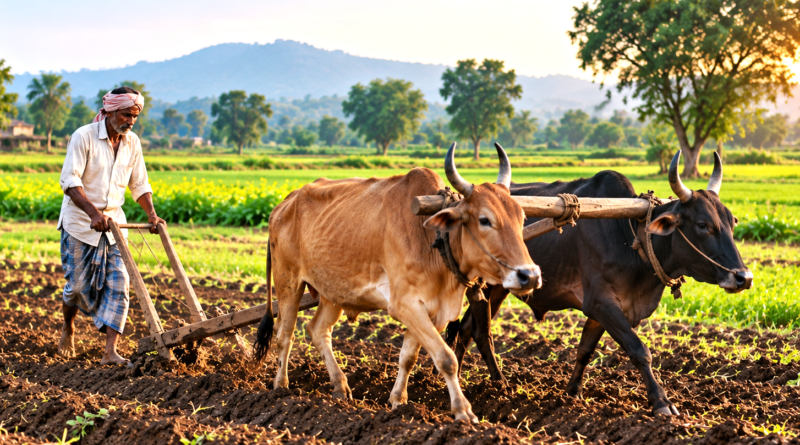
In some areas, draught animals were essential for ploughing, transporting produce, and performing other agricultural tasks. Although tractors and other machines have replaced much of this work in many regions, livestock remains important to numerous small and marginal farming households.
Integrated farming can also include fish cultivation, vegetable production, orchards, and poultry. Diversifying activities helps farmers use land and resources more effectively while creating several potential income sources.
However, livestock management requires adequate fodder, clean water, veterinary care, and responsible waste handling. Traditional systems work best when adapted to present-day resource constraints and animal welfare needs.
7. Natural Pest Management and Indigenous Knowledge
Traditional farmers have long relied on observation to identify crop pests, beneficial insects, seasonal changes, and signs of plant disease. This knowledge continues to influence pest management in many agricultural communities.
Practices include removing affected plant material, maintaining field cleanliness, using physical barriers, rotating crops, and encouraging natural predators. Some farmers also use locally prepared plant-based mixtures, including neem-based preparations, as part of their pest-management strategies.
The principle behind many of these methods is prevention. Rather than responding only after a pest population becomes severe, farmers can reduce risks through field monitoring, crop diversity, and appropriate cultivation practices.
Modern agriculture has expanded these ideas through integrated pest management, which combines biological, cultural, physical, and carefully selected chemical controls. The objective is to manage pests effectively while reducing unnecessary pesticide use and protecting beneficial organisms.
Traditional remedies should not automatically be assumed safe or effective. Their preparation, concentration, and application matter, and some mixtures may harm crops, people, or beneficial insects. Scientific evaluation can help distinguish useful practices from those requiring modification.
Combining farmers’ observations with modern pest identification and monitoring tools creates a more reliable approach to crop protection.
8. Regional Farming Traditions and Local Adaptation
India’s agricultural diversity reflects its varied geography and cultural traditions. Traditional practices differ significantly between regions because rainfall, temperature, soil characteristics, and available resources are not uniform.
In the Himalayan region, terrace farming allows cultivation on slopes while helping manage runoff and soil erosion when terraces are properly maintained. In northeastern India, farming communities have developed diverse systems involving rice, vegetables, and other locally suitable crops. In dry regions, millets and pulses have historically helped households cope with limited rainfall.
Coastal communities often cultivate crops suited to humid conditions, while farmers in the northern plains have developed seasonal systems around rice, wheat, sugarcane, and other crops.
Traditional agricultural calendars also reflect local observations of rainfall, temperature, and seasonal transitions. Farmers have historically used these patterns to decide when to sow and harvest.
Climate change is making such decisions more difficult because established seasonal patterns may no longer be as dependable. Traditional knowledge remains useful, but it needs to be updated with weather forecasts, soil information, and changing climate conditions.
The continuing value of regional farming traditions lies in their flexibility and their close connection to local environments.
9. The Economic Importance of Traditional Farming Practices
Traditional farming methods can influence household finances by helping farmers manage input costs, diversify production, and make use of locally available resources.
Producing compost from farm waste, preserving suitable seeds, and maintaining shared irrigation structures may reduce dependence on some purchased inputs. Mixed cropping can provide multiple harvests or income streams, reducing the financial risks associated with a single crop.
Traditional agricultural products may also offer opportunities in specialized markets. Indigenous rice varieties, traditional millets, region-specific pulses, and locally distinctive agricultural produce can attract consumers interested in food diversity and regional heritage.
Farmer groups and cooperatives can strengthen these opportunities by organizing storage, processing, packaging, and marketing. Without reliable market access, however, growing a traditional crop does not necessarily guarantee higher returns.
Traditional practices may also require additional labour, and some methods are less suitable for large-scale mechanized cultivation. Their economic value therefore depends on labour availability, farm size, local demand, yields, and production costs.
The objective should not be to preserve every traditional practice unchanged. Instead, farmers need the freedom to retain methods that deliver practical benefits and adapt those that no longer meet their needs.
10. Challenges in Preserving Traditional Agricultural Knowledge
Despite their continuing importance, traditional farming practices face several challenges. Urbanization, migration, changing occupations, and declining interest among some younger people can weaken the transfer of agricultural knowledge between generations.
The expansion of commercial agriculture has also encouraged greater dependence on standardized seeds, fertilizers, pesticides, and machinery in many areas. These inputs can improve productivity, but excessive or poorly managed use may increase costs and contribute to soil, water, and environmental problems.
Another challenge is the gradual disappearance of indigenous crop varieties. When farmers repeatedly cultivate a narrow selection of commercially popular crops, locally adapted varieties may become less common.
Traditional water systems can also fall into disrepair when communities lack the funding or collective support required for maintenance.
Preserving useful agricultural knowledge requires more than documenting old techniques. Farmers need access to training, suitable credit, dependable markets, research support, and opportunities to experiment with improved methods. Agricultural institutions can help by recording local knowledge and evaluating it alongside scientific evidence.
Supporting farmers as knowledge holders and decision-makers is essential to keeping agricultural traditions relevant.
11. Combining Traditional Knowledge with Modern Technology
The future of Indian agriculture does not require choosing between traditional methods and modern technology. A combination of both can provide a more practical and resilient path forward.
For example, a farmer can preserve an indigenous seed variety while using modern seed testing and storage techniques. Traditional composting can be supported by soil analysis to identify nutrient deficiencies. Rainwater harvesting can work alongside drip irrigation, while crop rotation can be planned using information about local pest patterns.
Weather forecasting applications can help farmers compare established seasonal knowledge with current predictions. Soil sensors and digital advisory services can support irrigation decisions without replacing farmers’ understanding of their land.
Agricultural research can also evaluate traditional crop varieties for nutritional qualities, climate resilience, and commercial potential. Successful varieties may then be conserved and developed further through responsible breeding programmes.
This approach recognizes that traditional knowledge and scientific research are complementary. Farmers contribute practical experience accumulated over generations, while modern science provides tools to test assumptions, measure results, and address emerging problems.
The most effective agricultural decisions will depend on local needs rather than a single universal model.
Conclusion
Traditional farming practices continue to shape Indian agriculture through seed preservation, crop rotation, mixed farming, organic soil management, water conservation, livestock integration, and locally adapted cultivation methods. These practices represent generations of learning about the relationship between agricultural production and the natural environment.
Their importance extends beyond cultural heritage. Many traditional methods offer practical ways to diversify crops, recycle resources, conserve water, maintain soil quality, and reduce farming risks. At the same time, traditional approaches have limitations and must respond to changing economic conditions, environmental pressures, and the needs of modern food production.
India’s agricultural future will depend on its ability to combine useful traditional knowledge with scientific research, improved infrastructure, appropriate machinery, and digital innovation. Farmers should be encouraged to evaluate different approaches according to their land, resources, and market opportunities.
By protecting valuable indigenous knowledge while remaining open to innovation, India can develop agricultural systems that respect its farming heritage and respond to contemporary challenges. Traditional farming is not merely a chapter in India’s agricultural history; it remains an evolving influence on how the country cultivates its land, supports rural livelihoods, and works towards a more sustainable food future.