
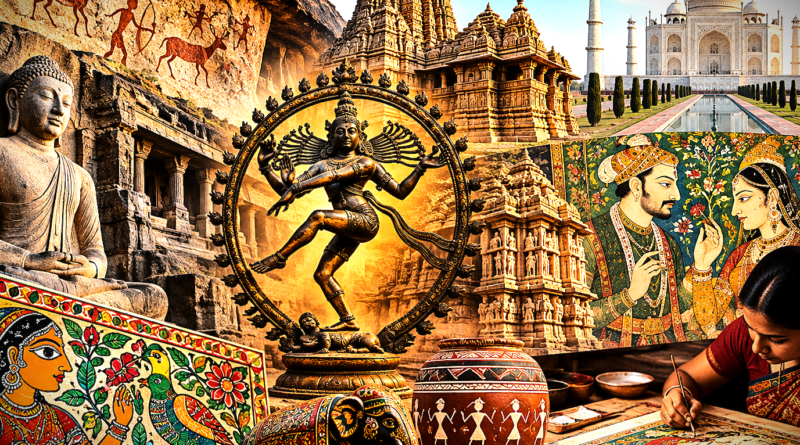
The History of Indian Art and Its Cultural Significance – India Times Group
Exploring the Evolution of Indian Artistic Traditions, From Ancient Cave Paintings to Modern Creative Expressions
Introduction
Indian art is one of the richest and most diverse artistic traditions in the world. Developed over thousands of years, it reflects the country’s changing civilizations, spiritual beliefs, social structures, regional identities, and creative imagination. From prehistoric cave paintings and ancient sculptures to magnificent temple architecture, intricate textiles, miniature paintings, and contemporary installations, Indian art has continuously evolved while maintaining connections with its cultural roots.
Art in India has never been limited to decoration or visual beauty. It has served as a medium for expressing religious ideas, preserving historical memories, communicating philosophical concepts, celebrating nature, and recording everyday life. Different communities have developed distinctive artistic practices, influenced by geography, available materials, local customs, and interactions with other cultures.
The history of Indian art also reveals how traditions adapt to changing circumstances. Political developments, religious movements, trade, colonial influence, and technological progress have introduced new ideas and techniques. Despite these transformations, Indian artists have repeatedly found ways to connect innovation with inherited knowledge.
Understanding Indian art therefore means exploring more than paintings, sculptures, and monuments. It involves examining the beliefs, experiences, and values of the people who created them and the societies in which they flourished.
1. The Earliest Expressions of Indian Art
The roots of Indian artistic expression extend into prehistoric times, when early communities used natural surfaces to communicate through images and symbols. Rock shelters across the Indian subcontinent preserve paintings depicting animals, human figures, hunting activities, dancing, and collective gatherings.
These early artworks demonstrate that artistic creativity was connected with ordinary human experiences. People observed their surroundings and represented the animals, landscapes, and activities that shaped their lives. The use of simple forms and repeated patterns suggests an interest in communicating ideas through visual means.
Natural pigments, including mineral-based colors, helped artists create images on rock surfaces. Although the precise meanings of many prehistoric paintings remain uncertain, they offer valuable clues about human interaction with nature and the development of visual storytelling.
Later, the Indus Valley Civilization introduced sophisticated artistic practices. Small sculptures, pottery designs, seals, ornaments, and terracotta figures reveal considerable skill in shaping materials and creating detailed forms.
The civilization’s seals are particularly notable for their compact designs, carefully carved animals, and symbolic markings. Terracotta objects and decorative pottery also demonstrate that artistic production was part of daily life.
These discoveries indicate that early Indian art developed through multiple purposes, including practical use, personal adornment, symbolic communication, and possibly ritual activities. Its foundations were closely connected with the environments and communities that sustained it.
2. Art During the Ancient Indian Period
As organized kingdoms and religious traditions developed, Indian art became increasingly sophisticated. Artists began creating monumental structures, stone sculptures, architectural decorations, and objects associated with religious and political institutions.
The Mauryan period marked an important stage in the development of monumental stone art. Carefully polished pillars, animal capitals, and sculptural works demonstrated advanced craftsmanship and the ability to transform stone into impressive public monuments.
These structures also carried political and ethical messages. Rulers used inscriptions and architectural projects to communicate ideas about governance, moral conduct, and social responsibility.
During subsequent centuries, Buddhist art developed through stupas, railings, relief sculptures, and monasteries. Artists represented important episodes associated with the Buddha’s life and teachings. Early Buddhist imagery sometimes communicated the Buddha’s presence through symbolic forms, including the wheel, footprints, and the Bodhi tree.
Over time, recognizable images of the Buddha became increasingly prominent in different artistic traditions. Regional styles emerged, reflecting variations in materials, artistic preferences, and cultural contact.
Hindu and Jain art also expanded during the ancient period. Sculptures representing deities, religious narratives, and philosophical ideas became important elements of sacred architecture.
These artistic traditions established visual languages through which complex beliefs could be communicated to communities with different levels of literacy. Images, symbols, and architectural spaces became powerful instruments for preserving and sharing cultural knowledge.
3. The Importance of Buddhist Cave Art
Buddhist cave complexes represent some of the most remarkable achievements in Indian artistic history. Places such as Ajanta demonstrate how architecture, painting, and sculpture could work together to create meaningful religious environments.
Ajanta’s painted interiors contain figures of the Buddha, scenes associated with earlier lives, royal gatherings, merchants, musicians, and ordinary human experiences. The compositions reveal an understanding of facial expression, gesture, clothing, movement, and spatial arrangement.
The paintings also provide valuable information about historical life. Details of jewelry, textiles, architecture, and social interactions offer glimpses into the visual culture of earlier periods.
Creating these works required extensive preparation and collaboration. Artists worked with prepared surfaces, mineral pigments, brushes, and carefully planned compositions. The survival of portions of these paintings is especially significant because many ancient artworks have disappeared through time.
Other cave complexes, including those at Ellora, demonstrate the remarkable range of religious and artistic traditions that developed within the subcontinent. Buddhist, Hindu, and Jain monuments exist within the same broad landscape, illustrating the diversity of India’s religious heritage.
Cave art shows that Indian artistic traditions were not confined to portable objects. Entire architectural spaces could become artistic environments where storytelling, worship, learning, and community life came together.
4. Temple Architecture and the Development of Sculpture
Temple architecture became one of the most influential forms of artistic expression in India. Temples were designed not merely as buildings but as sacred spaces in which architecture, sculpture, ornamentation, and religious symbolism supported one another.
Different regions developed distinctive architectural traditions. Northern Indian temples often adopted forms associated with the Nagara style, while many southern temples developed Dravida characteristics. Other regions combined elements in ways that reflected local histories and artistic preferences.
The exteriors of many temples feature sculpted deities, celestial figures, animals, floral designs, dancers, and scenes from religious narratives. These images transform stone surfaces into detailed visual compositions.
Temple sculpture also reveals the importance of proportion, movement, balance, and symbolic gestures. Artists followed established conventions while demonstrating considerable creativity in their interpretation of traditional subjects.
The Chola period in southern India became particularly renowned for bronze sculpture. Images of Hindu deities, including the celebrated dancing form of Shiva, demonstrate an exceptional combination of technical skill, expressive movement, and religious meaning.
Temple complexes also supported communities of artisans, architects, sculptors, metalworkers, and painters. Artistic production therefore contributed to regional economies and the transmission of specialized knowledge.
Even today, historical temples remain important cultural landmarks. They preserve artistic achievements while continuing to influence architecture, sculpture, religious practice, and contemporary design.
5. The Growth of Classical Painting Traditions
Indian painting developed through a wide variety of materials, techniques, and regional traditions. While some paintings decorated cave walls and temples, others appeared in manuscripts, royal courts, religious collections, and household settings.
Classical painting traditions often combined narrative storytelling with decorative detail. Artists used color, line, gesture, and symbolic imagery to communicate emotional and philosophical ideas.
The themes varied considerably. Religious stories, royal ceremonies, courtly life, landscapes, music, seasons, and romantic poetry all became subjects for artistic exploration.
Miniature painting emerged as an especially refined tradition in several parts of the subcontinent. These works frequently used carefully controlled lines, detailed costumes, expressive faces, and elaborate backgrounds.
Rather than depending exclusively on realistic perspective, many Indian painting traditions arranged figures and spaces according to narrative importance. Multiple events could appear within a composition, allowing the viewer to follow a story through visual details.
Manuscript painting also played a significant role in preserving knowledge. Illustrated religious and literary texts combined written language with images, making artistic expression an important companion to scholarship.
The variety of painting traditions demonstrates that Indian art developed through multiple centers rather than following a single uniform style. Each region contributed distinctive approaches while participating in a broader exchange of artistic ideas.
6. Mughal Art and Cultural Exchange
The Mughal period introduced important developments in court painting, portraiture, book illustration, decorative arts, and architecture. Mughal artistic traditions brought together Persian influences, Indian craftsmanship, and ideas drawn from other cultural contacts.
Court workshops employed artists who collaborated on illustrated manuscripts, historical chronicles, portraits, and scenes of royal life. Their paintings often displayed close attention to clothing, plants, animals, facial features, and ceremonial objects.
Portraiture became an important means of documenting rulers, nobles, and courtly relationships. Artists developed detailed techniques for representing individuals while also communicating rank and authority.
Mughal architecture produced some of India’s most recognizable monuments. Buildings such as the Taj Mahal demonstrate how architecture, gardens, geometric planning, stone carving, and decorative inlay could be integrated into a carefully organized composition.
The period also encouraged artistic exchange. Techniques and visual preferences moved between workshops, while regional artists adapted imported ideas to local traditions.
As Mughal political influence changed, related artistic practices continued in regional courts. Rajput and Pahari painting traditions developed their own approaches to religious stories, poetry, courtly life, and landscapes.
This history demonstrates that cultural exchange does not necessarily erase local identity. Instead, interactions between artistic traditions can create new forms of expression that retain elements of multiple influences.
7. Folk and Tribal Art: The Voice of Local Communities
India’s artistic heritage extends far beyond royal workshops, monuments, and classical institutions. Folk and tribal art traditions represent the creativity, knowledge, and cultural identity of communities across the country.
Madhubani painting from Bihar is known for its intricate patterns, expressive figures, and subjects drawn from nature, mythology, and social life. Warli art from Maharashtra frequently uses geometric human figures to portray farming, dancing, village activities, and relationships with the natural world.
Pattachitra traditions from Odisha and neighboring regions are recognized for their carefully outlined figures, decorative borders, and narrative themes. Gond art, associated with communities in central India, often transforms animals, plants, and familiar surroundings into intricate patterns and rhythmic compositions.
These traditions have historically been connected with household decoration, festivals, rituals, community storytelling, and the transmission of inherited knowledge.
Materials and methods vary between communities. Artists may use natural pigments, handmade paper, cloth, walls, wood, or other locally available surfaces.
Many folk and tribal traditions are learned through family and community participation rather than formal academic instruction. Their knowledge systems preserve distinctive approaches to color, symbolism, storytelling, and relationships with the environment.
Today, many artists adapt traditional practices for galleries, books, exhibitions, and international audiences. Such opportunities can create income and recognition, although responsible representation is essential to ensure that communities retain credit, agency, and economic benefits.
8. Indian Art During the Colonial Period
British colonial rule brought major changes to India’s artistic environment. European academic methods, new educational institutions, photography, printing technologies, and commercial art markets influenced how artists learned and presented their work.
Art schools introduced systematic training in anatomy, perspective, shading, and naturalistic representation. Some Indian artists adopted these methods, combining them with subjects and visual traditions drawn from local life.
At the same time, colonial artistic institutions sometimes treated European approaches as superior to indigenous practices. This created tensions about cultural identity, artistic authority, and the value of traditional knowledge.
In response, several artists and intellectuals began reconsidering India’s historical artistic heritage. The Bengal School became associated with efforts to develop an artistic language that drew upon Indian themes and selected Asian influences rather than simply reproducing European academic conventions.
Artists explored historical subjects, spiritual ideas, literary themes, and national identity. Art became increasingly connected with discussions about cultural independence and the meaning of modern India.
Printing also made images more accessible to wider audiences. Religious pictures, illustrated publications, and commercial artworks circulated beyond elite institutions.
The colonial period was therefore not simply a period of foreign influence. It was also a time of artistic debate, experimentation, resistance, and renewed interest in India’s cultural traditions.
9. Modern and Contemporary Indian Art
After independence in 1947, Indian artists faced new questions about national identity, social change, urbanization, and the relationship between tradition and modernity.
Many explored abstraction, expressive forms, unconventional materials, and new approaches to painting and sculpture. Some continued working with recognizable subjects, while others used color, shape, and texture to communicate ideas without relying on detailed representation.
Modern Indian artists examined political developments, migration, inequality, personal identity, industrial growth, and changing social relationships. Their work reflected the experiences of a society undergoing rapid transformation.
Contemporary Indian art has expanded into photography, installation, video, digital media, performance, and interdisciplinary experimentation. Artists increasingly engage with environmental issues, gender, memory, technology, and global cultural exchange.
At the same time, traditional practices remain active. Contemporary artists may combine folk motifs, classical sculpture, indigenous materials, and digital techniques to create works that connect historical knowledge with present-day concerns.
Art galleries, museums, universities, public projects, and online platforms have widened opportunities for artists to reach audiences.
This diversity demonstrates that Indian art is not a fixed collection of historical styles. It remains a living practice that changes as artists respond to new ideas and circumstances.
10. The Cultural Significance of Indian Art
Indian art has contributed to cultural life in several interconnected ways.
First, it preserves historical memory. Paintings, monuments, sculptures, textiles, and manuscripts provide evidence of changing technologies, clothing, beliefs, social practices, and political relationships.
Second, art communicates philosophical and spiritual ideas. Symbols, stories, sacred images, and architectural arrangements have helped communities express concepts that can be difficult to communicate through ordinary language alone.
Third, artistic traditions strengthen regional and community identities. Local patterns, materials, techniques, and stories distinguish one tradition from another while contributing to the country’s broader cultural diversity.
Fourth, art supports livelihoods. Craft production, textiles, sculpture, painting, architecture, restoration, and contemporary design provide employment for artists and skilled workers. Responsible support for these activities helps preserve knowledge while creating economic opportunities.
Finally, art encourages dialogue between generations and cultures. Historical artworks can inspire contemporary creators, while new interpretations can help younger audiences connect with their heritage.
Protecting artistic traditions therefore requires more than preserving objects in museums. It also involves supporting artists, documenting techniques, maintaining historical sites, encouraging education, and respecting the communities that sustain living traditions.
Conclusion
The history of Indian art is a story of continuity, transformation, and extraordinary diversity. From prehistoric rock paintings and the craftsmanship of the Indus Valley Civilization to Buddhist caves, temple sculptures, miniature paintings, folk traditions, and contemporary experimentation, each period has contributed new dimensions to the country’s artistic heritage.
Indian art has reflected religious beliefs, political changes, community relationships, everyday experiences, and evolving ideas about identity. It has also demonstrated how different cultural influences can interact without eliminating regional creativity.
Its significance lies not only in the beauty of individual works but also in the knowledge, memories, and values they carry. These artistic expressions help explain how communities have understood their world and communicated their experiences across generations.
Preserving this heritage requires protecting monuments, supporting traditional craftspeople, encouraging young artists, and making artistic education accessible. It also requires recognizing that living traditions must have room to adapt and grow.
Ultimately, Indian art remains an essential part of the country’s cultural identity. Its long history offers a valuable reminder that creativity can connect the past with the present while opening new possibilities for the future.