
The Beauty of Indian Rangoli Designs: A Colorful Expression of Culture and Tradition – India Times Group
Introduction
India is a land of diverse cultures, vibrant festivals, ancient traditions, and artistic expressions that reflect the spirit of its people. Among its many traditional art forms, Rangoli holds a special place in Indian homes and communities. Created with colorful powders, flower petals, rice flour, and other natural materials, Rangoli transforms ordinary floors into beautiful works of art. These decorative designs are more than simple patterns; they represent hospitality, creativity, prosperity, and the deep cultural values passed from one generation to another.
Rangoli is commonly created at entrances, courtyards, prayer spaces, and public gathering areas, particularly during festivals and family celebrations. Its beauty lies not only in its colors and symmetry but also in the emotions and traditions associated with its creation. From simple geometric patterns to elaborate floral arrangements, every design reflects the imagination and artistic skill of its creator.
Although Rangoli styles vary across regions, the underlying idea remains remarkably consistent: using art to welcome positive experiences, celebrate important occasions, and bring people together. In modern India, this traditional practice continues to evolve while preserving its cultural significance.
The Origins and Historical Significance of Rangoli
The tradition of decorating floors with artistic patterns has deep roots in Indian cultural history. For centuries, households have used natural materials to create designs that beautify living spaces and mark special occasions. These practices developed differently across regions, reflecting local environments, beliefs, available materials, and community customs.
Historically, many Rangoli patterns were created using rice flour, ground limestone, turmeric, flower petals, and colored earth. These materials were readily available and allowed families to create decorative designs without requiring expensive equipment. Some communities preferred temporary patterns that could be renewed daily, while others developed elaborate designs for weddings, religious ceremonies, and major festivals.
Traditional floor art often carried symbolic meanings. Circles could suggest continuity, flowers could represent beauty and renewal, and symmetrical arrangements could express balance and harmony. Certain motifs were associated with auspicious occasions, although their interpretations varied among communities.
Rangoli was also a practical expression of hospitality. A decorated entrance communicated that a household was prepared to welcome guests and participate in a celebration. The act of creating the design became as meaningful as the finished artwork itself.
Over time, Rangoli developed into a recognizable feature of India’s artistic heritage. Despite changes in lifestyles and materials, the tradition remains closely connected to family customs, seasonal celebrations, and community identity.
Regional Diversity in Indian Rangoli Art
One of the most fascinating aspects of Rangoli is the diversity of its regional forms. Although different styles share the idea of decorating the ground with patterns, their techniques, names, and visual characteristics can differ considerably.
Kolam of Tamil Nadu
In Tamil Nadu, Kolam is a traditional form of floor decoration commonly created outside homes, often early in the morning. Designs frequently use white rice flour arranged into symmetrical patterns, with dots serving as guides for intricate lines.
Kolam designs may appear simple at first glance, but their mathematical structure can be remarkably sophisticated. Continuous lines weave around dots, forming balanced compositions that demonstrate patience, precision, and spatial understanding.
Some families create new patterns every day, while others preserve traditional designs associated with festivals and special occasions. Kolam is therefore both a visual art form and a daily cultural practice.
Alpana of West Bengal
In West Bengal, Alpana is traditionally created using a mixture of rice flour and water. The designs often feature circular arrangements, flowers, leaves, footprints, and symbolic figures.
Unlike Rangoli styles that emphasize multiple bright colors, traditional Alpana frequently relies on white patterns against a darker floor. The resulting contrast creates an elegant and distinctive appearance.
Alpana is particularly associated with religious ceremonies, seasonal festivals, and family rituals. Its flowing lines and delicate motifs demonstrate how simple materials can produce sophisticated artistic effects.
Muggu of Andhra Pradesh and Telangana
In Andhra Pradesh and Telangana, Muggu is widely practiced as a traditional floor-art form. White powder is commonly used to create geometric arrangements, while colored powders may be added for special celebrations.
During Sankranti, households often create larger and more colorful designs. Floral shapes, intersecting lines, dots, and symmetrical figures are arranged into compositions that celebrate the harvest season and family traditions.
Muggu illustrates the relationship between mathematics and creativity. Artists must consider spacing, balance, and the movement of lines while transforming a basic grid into an attractive design.
Mandana of Rajasthan and Madhya Pradesh
Mandana is a traditional decorative art associated with parts of Rajasthan and Madhya Pradesh. Designs are often created on walls and floors using white pigment against surfaces prepared with red earth or clay.
Common motifs include geometric shapes, animals, plants, and symbolic figures. The strong contrast between the background and the white patterns gives Mandana a distinctive visual character.
The art form is closely connected with household rituals, festivals, and celebrations. It also reflects regional building traditions and the creative use of locally available materials.
Pookalam of Kerala
Kerala is particularly known for Pookalam, a floral arrangement created using fresh flower petals, especially during the Onam festival. Unlike powder-based Rangoli, Pookalam relies on the natural colors and textures of flowers.
The designs are generally circular and may consist of several concentric layers. Yellow, orange, white, pink, and red petals are arranged carefully to create elaborate patterns.
Pookalam is often a collective activity involving families, neighbors, and community groups. The process encourages cooperation while celebrating Kerala’s cultural identity and the festive spirit of Onam.
The Symbolism Behind Rangoli Designs
Rangoli’s beauty becomes more meaningful when its symbolism is understood. Many traditional designs are created to express ideas of welcome, prosperity, harmony, and renewal.
Flowers and leaves are among the most common motifs. They represent natural beauty, growth, and the changing seasons. Lotus-inspired designs, in particular, hold cultural and spiritual significance in many Indian traditions.
Geometric patterns demonstrate balance and order. Repeated triangles, squares, circles, and intersecting lines create compositions that are visually appealing because of their symmetry and rhythm.
Peacocks and birds are frequently used to introduce movement, elegance, and a connection with nature. Their colorful feathers make them particularly suitable for elaborate festive designs.
Diyas and lamps symbolize light, hope, and celebration. They are especially common during Diwali, when households decorate entrances and courtyards to mark the festival.
Footprints and auspicious symbols may be included in designs created for religious occasions. Their meanings depend on the traditions and beliefs of the community.
These symbols are not interpreted identically throughout India. Their significance varies according to regional customs, religious practices, and family traditions. This diversity makes Rangoli a rich and adaptable cultural art form.
Rangoli and the Celebration of Indian Festivals
Festivals provide some of the most important occasions for creating Rangoli. The designs often become part of the visual identity of celebrations, making homes, temples, and public spaces feel more welcoming.
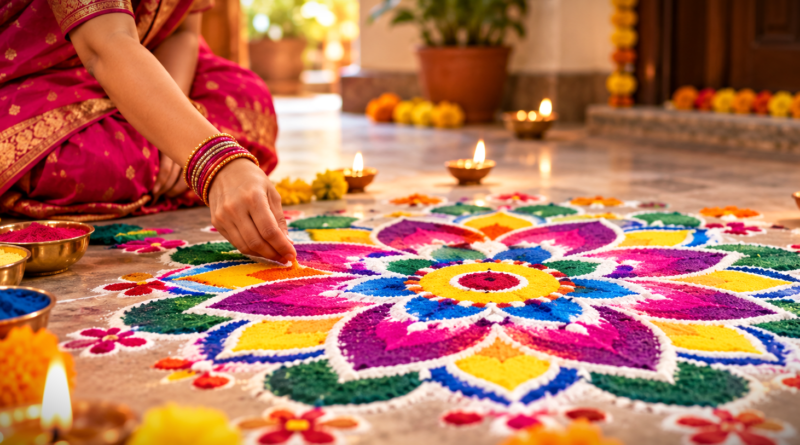
During Diwali, colorful Rangoli patterns are frequently placed near entrances and prayer areas. Families may surround the designs with diyas, creating an atmosphere of warmth and celebration. Floral arrangements, lotus motifs, and geometric patterns are particularly popular.
During Onam, Pookalam becomes an important part of Kerala’s festive celebrations. Families and community groups use fresh flowers to build increasingly elaborate arrangements, often involving several generations.
Makar Sankranti and Pongal are also associated with floor-art traditions in different parts of India. Harvest-related designs may feature sugarcane, pots, flowers, and sun motifs, reflecting gratitude for agricultural abundance.
Rangoli also appears at weddings, housewarming ceremonies, religious observances, and other family milestones. Designs are adapted to the occasion, with some emphasizing simplicity and others featuring detailed patterns and bright colors.
Through these celebrations, Rangoli becomes a way of expressing happiness and strengthening cultural connections.
The Importance of Colors in Rangoli
Color is one of the most striking features of contemporary Rangoli. A carefully selected combination of shades can transform a simple arrangement into a visually memorable composition.
Red is often associated with celebration, energy, and auspicious occasions. Yellow suggests warmth and brightness, while green evokes plants, renewal, and nature. Blue can introduce depth and contrast, while white provides clarity and highlights the structure of a design.
Artists may use contrasting colors to make individual shapes stand out or select neighboring shades to create a softer appearance. Symmetry, spacing, and the distribution of colors all influence the final result.
Traditional artists often used natural pigments, rice flour, turmeric, and flower petals. Today, commercially available colored powders, chalk, and other decorative materials offer additional choices. Fresh petals and leaves remain popular for people who prefer organic textures.
The most effective designs do not necessarily require the greatest number of colors. Even two or three well-chosen shades can produce an elegant result when the patterns are carefully planned.
Rangoli as an Expression of Creativity and Skill
Creating Rangoli requires a combination of imagination, concentration, and practical skill. Artists must consider the size of the available space, the arrangement of motifs, the relationship between colors, and the overall balance of the composition.
Some designs are created freehand, allowing the artist to develop patterns spontaneously. Others follow a grid of dots or a carefully drawn outline. Complex arrangements may require repeated shapes, consistent spacing, and precise curves.
Beginners often start with simple flowers, circles, diamonds, and symmetrical borders. With practice, these basic elements can be combined into more elaborate compositions featuring multiple layers and intricate details.
Rangoli also encourages experimentation. Artists can combine traditional motifs with contemporary patterns, abstract shapes, or modern color combinations while retaining the recognizable features of Indian floor art.
The creative process can be relaxing because it encourages attention to detail and provides an opportunity to focus on a single activity. Families can use it as a shared pastime, while schools and community organizations can introduce children to traditional design techniques.
Rangoli in Modern Homes and Public Spaces
Although Rangoli remains rooted in tradition, its appearance has changed with contemporary lifestyles. Urban homes, apartment buildings, offices, shopping centers, hotels, and public venues increasingly incorporate decorative Rangoli during festivals and special events.
Limited space has encouraged the development of compact designs suitable for doorways, balconies, and entrance halls. Larger public installations may feature elaborate floral arrangements, artistic borders, and coordinated color schemes.
Digital technology has also influenced the way people learn and share Rangoli. Photographs, online tutorials, and design applications allow artists to discover patterns from different regions and adapt them to their own preferences.
Reusable stencils and ready-made templates provide additional options for those who have limited time or experience. However, handmade designs continue to hold special appeal because they reflect individual effort and creativity.
Contemporary artists sometimes experiment with three-dimensional effects, layered materials, and unusual combinations of traditional and modern motifs. These innovations demonstrate that cultural preservation does not require artistic traditions to remain unchanged.
Instead, Rangoli can continue developing while maintaining its connection with Indian heritage.
The Role of Rangoli in Preserving Cultural Heritage
Traditional art forms survive when people continue practicing them, teaching them, and finding new reasons to value them. Rangoli provides a particularly accessible way to preserve cultural knowledge because it can be created at home using relatively simple materials.
Grandparents and parents often teach younger family members familiar designs, techniques, and stories associated with particular occasions. Children learn through observation and participation, gradually developing an understanding of regional customs.
Community competitions, school activities, cultural festivals, and exhibitions also provide opportunities to introduce Rangoli to new audiences. Such activities encourage people to explore artistic traditions beyond their immediate communities.
Preservation should include respect for regional differences. Kolam, Alpana, Muggu, Mandana, and Pookalam have their own histories and techniques, and their individual identities deserve recognition.
By learning about these variations, people can appreciate India’s cultural diversity without treating every form of floor art as identical.
Environmental Awareness and Sustainable Rangoli
Traditional Rangoli often relies on materials obtained from nature, but modern decorative products can sometimes create unnecessary waste. Synthetic colors, plastic decorations, and non-biodegradable materials may be difficult to dispose of responsibly.
Environmentally conscious alternatives include flower petals, rice flour, natural pigments, leaves, and other locally available materials. These options can reduce reliance on certain synthetic products, although their environmental impact still depends on how they are produced and used.
Artists can also avoid excessive packaging, reuse suitable decorative tools, and choose materials that are safe for household members and pets.
For outdoor designs, it is important to consider how powders and loose materials may affect nearby plants, animals, and people with respiratory sensitivities. Using suitable quantities and cleaning the area responsibly can make the practice more considerate of its surroundings.
Sustainable Rangoli does not need to sacrifice beauty. Natural colors and floral arrangements can create delicate, vibrant designs that celebrate both artistic creativity and the environment.
Conclusion
The beauty of Indian Rangoli designs lies in their ability to unite art, culture, tradition, and everyday life. From the precise lines of Kolam to the floral richness of Pookalam and the contrasting patterns of Mandana, each regional form contributes to India’s remarkable artistic diversity.
Rangoli beautifies homes, enriches festivals, welcomes guests, and creates opportunities for families and communities to participate in a shared cultural practice. Its colors and symbols communicate ideas of harmony, celebration, and renewal, while its techniques demonstrate the connection between creativity and mathematical thinking.
As lifestyles change, Rangoli continues to find new expressions in modern homes, public spaces, schools, and digital communities. Its future depends on appreciating regional traditions, encouraging younger generations to participate, and adapting materials and techniques responsibly.
Ultimately, Rangoli is more than decoration on the floor. It is a living expression of Indian heritage, shaped by countless hands and renewed through every pattern created. Its lasting beauty comes not only from the colors arranged on the ground but also from the memories, relationships, and cultural values that each design helps preserve.