
The Indus Valley Civilization: Secrets of an Ancient Urban World – India Times Group
Uncovering the remarkable cities, ingenious engineering, mysterious script, and forgotten stories of one of humanity’s earliest urban societies
The Indus Valley Civilization remains one of the most fascinating chapters in human history. Flourishing thousands of years ago across present-day Pakistan and northwestern India, this ancient society developed carefully planned cities, sophisticated drainage systems, specialized industries, and extensive trading networks. Its achievements demonstrate that urban planning, engineering, and organized community life existed long before the rise of many familiar historical empires.
Yet, despite remarkable archaeological discoveries, the civilization continues to guard numerous secrets. Researchers have not conclusively deciphered its writing system, its political organization remains uncertain, and the reasons behind the gradual transformation of its major cities are still debated. Every discovery provides another glimpse into a society whose accomplishments were extraordinary for its time.
Understanding the Indus Valley Civilization means exploring not only its impressive architecture but also the people who built its cities, cultivated its fields, produced its crafts, and established connections with distant lands.
1. The Origins of an Ancient Civilization
The Indus Valley Civilization, also known as the Harappan Civilization, developed from earlier farming communities that gradually became more complex. Its mature urban phase is generally dated to approximately 2600 BCE to 1900 BCE, although its cultural foundations developed centuries earlier.
The civilization extended across a vast geographical region encompassing parts of modern Pakistan and India. Its settlements appeared near rivers, fertile plains, coastal areas, and dry landscapes. This geographical diversity influenced agriculture, transportation, settlement patterns, and the availability of natural resources.
Early communities depended heavily on farming and animal husbandry. As agricultural production improved, some settlements generated enough surplus food to support larger populations and people working in specialized occupations.
Craftspeople could concentrate on producing pottery, ornaments, tools, and other goods, while traders transported materials between settlements. Gradually, these activities encouraged the growth of interconnected communities and major urban centers.
Unlike some ancient societies known for enormous royal tombs and monumental palaces, the Indus Valley Civilization is particularly famous for practical urban design. Its surviving buildings reveal a strong emphasis on residential planning, water management, and standardized construction.
2. Harappa and Mohenjo-daro: Remarkable Ancient Cities
Harappa and Mohenjo-daro are among the most important archaeological sites associated with the civilization. Their remains provide valuable evidence of how Harappan communities organized urban life.
Mohenjo-daro contained residential neighborhoods, wells, drainage channels, public structures, and streets arranged in a planned layout. Harappa also featured substantial brick buildings and evidence of organized settlement development.
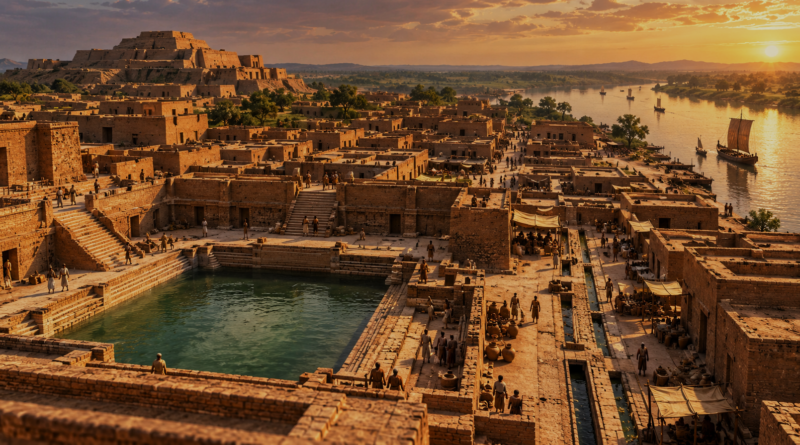
One of Mohenjo-daro’s most remarkable structures is the Great Bath, a carefully constructed rectangular basin with waterproofing and arrangements for supplying and removing water. Its precise purpose remains uncertain, although researchers have suggested that it may have served communal or ceremonial functions.
Many houses contained multiple rooms, and some included courtyards that provided light and ventilation. Buildings were frequently constructed with standardized bricks, indicating the use of established building practices.
These features suggest that urban development required considerable coordination. Roads, houses, wells, and drainage systems needed to function together rather than as unrelated structures.
The cities also demonstrate that sophisticated urban life did not necessarily depend on enormous monuments celebrating individual rulers. Their architecture instead highlights the importance of infrastructure and organized communities.
3. Advanced Drainage and Water Management
One of the most impressive achievements of the Indus Valley Civilization was its approach to sanitation and water management.
Many excavated houses contained bathing areas, while wells provided access to water in several settlements. Wastewater could flow through small channels connected to larger drainage systems running alongside streets.
Some drains were covered with bricks or stone slabs, protecting the channels while allowing wastewater to move away from residential areas. Their construction required careful attention to slopes, connections, and the movement of water.
These systems suggest that Harappan builders understood the practical challenges of maintaining densely populated neighborhoods.
Water management also involved more than removing wastewater. Wells, reservoirs, and other water-related structures demonstrate the importance of obtaining and storing water under different environmental conditions.
The ancient settlement of Dholavira, located in present-day Gujarat, is particularly notable for its sophisticated water conservation arrangements. Its structures reveal how communities adapted urban planning to local conditions and the challenges of limited water availability.
Although the systems varied between settlements, their overall importance is unmistakable. The Harappans recognized that dependable water supplies and effective drainage were essential to successful community life.
Their achievements offer a striking reminder that sanitation and infrastructure were important concerns in the ancient world, not merely inventions of modern cities.
4. Everyday Life in Harappan Society
Behind the impressive architecture were ordinary people whose daily activities sustained the civilization.
Farmers cultivated crops, craftspeople manufactured useful objects, traders exchanged goods, and families managed household responsibilities. The exact occupations of individuals cannot always be determined, but archaeological evidence reveals a wide range of economic activities.
Agriculture included crops such as wheat and barley, along with other plants cultivated according to regional conditions. People raised animals, including cattle, sheep, and goats, while fishing and gathering provided additional resources in suitable environments.
Households used pottery vessels for cooking, storing food, and carrying water. Tools made from stone and metal supported agricultural work, construction, and specialized crafts.
Personal ornaments were also important. Beads, bangles, necklaces, and other decorative objects demonstrate considerable skill in working with different materials.
Evidence of textile production suggests that Harappan communities worked with fibers, including cotton. Although clothing rarely survives directly, textile-related discoveries provide clues about their practical and commercial activities.
Housing conditions varied, with differences in building size and layout. Some homes included several rooms arranged around courtyards, while others were comparatively modest.
Together, these findings reveal a society whose complexity rested on everyday cooperation. The civilization’s impressive cities could not have existed without the farmers, laborers, artisans, and traders who maintained their economy.
5. Trade and Connections with Distant Civilizations
Trade helped connect the Indus Valley Civilization with neighboring regions and distant societies.
Archaeological evidence indicates commercial and cultural relationships with areas including Mesopotamia and regions surrounding the Persian Gulf. Some Mesopotamian records mention a land called Meluhha, commonly associated by many scholars with the Indus region.
Harappan craftspeople produced beads, pottery, ornaments, tools, and other objects that could circulate through regional and long-distance exchange networks.
Materials such as carnelian, lapis lazuli, and marine shells were valued for their appearance and usefulness. Their distribution suggests that raw materials and finished products moved between communities through multiple stages of exchange.
Seals are among the civilization’s most distinctive artifacts. Frequently carved from stone, they display animals, symbols, and short inscriptions. They may have helped identify individuals, organize commercial activities, or mark goods, although their exact purposes remain uncertain.
Standardized weights also suggest that consistent measurement played an important role in economic transactions.
Successful trade required reliable methods of measuring goods, specialized production, transportation, and communication. The widespread similarities between objects found at different settlements suggest that Harappan communities participated in shared economic and cultural practices.
These connections demonstrate that the Indus Valley Civilization was not isolated. It formed part of a wider ancient world in which goods, techniques, and ideas traveled across considerable distances.
6. The Undeciphered Script: An Unsolved Historical Mystery
The writing system of the Indus Valley Civilization remains one of its greatest mysteries.
Researchers have discovered inscriptions on seals, pottery, tablets, and other objects. However, no generally accepted decipherment has established what the signs mean or which language they represent.
Many inscriptions are short, sometimes containing only a few symbols. This makes it difficult to identify grammatical structures, vocabulary, or the relationship between written signs and spoken language.
The absence of a widely accepted bilingual inscription creates another major obstacle. Scholars lack a clear equivalent of the Rosetta Stone, which helped researchers decipher ancient Egyptian hieroglyphs.
The script may have been used for identification, administration, exchange, or other purposes, but its precise role remains uncertain.
A successful decipherment could transform our understanding of Harappan society. It might reveal information about personal names, political relationships, religious beliefs, commercial practices, or community organization.
Until then, researchers must rely primarily on archaeological evidence rather than readable historical documents.
The symbols remain a remarkable reminder that an advanced civilization can leave behind substantial material evidence while keeping much of its intellectual world beyond modern understanding.
7. Religion, Symbols, and Spiritual Beliefs
The religious beliefs of the Indus Valley Civilization are difficult to reconstruct because its writing remains undeciphered and the meaning of many artifacts is uncertain.
Archaeologists have discovered figurines, animal representations, seals, and unusual objects that may have held symbolic or ritual significance.
Some figurines have been interpreted as fertility symbols or representations of female deities. Other seals depict human-like figures surrounded by animals, leading to suggestions that they may represent religious or ceremonial themes.
However, these interpretations remain debated. An object’s appearance alone cannot establish its religious meaning.
The Great Bath at Mohenjo-daro has also been linked to possible purification ceremonies, but there is no conclusive evidence establishing its exact function.
The Harappans may have maintained beliefs connected with animals, natural forces, water, or community rituals. Nevertheless, their precise religious practices remain largely unknown.
Careful interpretation is essential because similarities between ancient artifacts and later religious traditions do not automatically prove direct continuity.
The uncertainty surrounding Harappan beliefs makes this subject particularly intriguing. Future discoveries may help clarify how these communities understood their world and expressed their spiritual ideas.
8. Art, Technology, and Skilled Craftsmanship
The artistic achievements of the Indus Valley Civilization reveal a high level of technical ability.
Craftspeople worked with clay, copper, bronze, stone, shell, and semiprecious materials to produce household objects, tools, ornaments, and figurines.
The famous bronze Dancing Girl figurine from Mohenjo-daro demonstrates the skill of ancient metalworkers. Its distinctive posture and carefully rendered features suggest a sophisticated understanding of metal casting.
Bead-making was another specialized activity. Producing beads with consistent shapes and polished surfaces required suitable tools, material knowledge, and considerable patience.
Pottery makers created vessels for everyday use, sometimes decorating them with geometric patterns or other designs. Seal carvers produced compact objects featuring carefully arranged imagery and inscriptions.
Standardized bricks and weights provide further evidence of practical technical knowledge. These shared standards helped support construction and economic activities across numerous settlements.
Such achievements emerged through experience, experimentation, and the transmission of skills between generations. Although they did not represent modern scientific institutions, they demonstrate an impressive understanding of materials, measurement, and construction.
9. Why Did the Indus Valley Civilization Decline?
Around 1900 BCE, many major Harappan urban centers began to change. Large cities lost some of their earlier importance, settlement patterns shifted, and populations increasingly occupied different regions.
The transformation was probably influenced by several interconnected factors rather than one sudden catastrophe.
Changes in rainfall may have affected agricultural productivity and water availability. Shifting river channels could also have disrupted settlements that depended on reliable water supplies.
Economic changes may have contributed to the weakening of long-distance trading networks and specialized urban industries.
These developments did not affect every settlement equally. Some cities declined, while smaller communities continued or developed new patterns of habitation.
There is insufficient evidence to explain the entire transformation through a single invasion or disaster. Instead, archaeological evidence supports a more complicated picture involving environmental pressures, economic changes, and human adaptation.
The end of the mature urban phase did not mean that every Harappan community disappeared. People continued living in different regions, carrying forward aspects of earlier material culture and everyday practices.
The civilization’s transformation therefore represents a major historical transition rather than a simple story of sudden destruction.
10. The Enduring Legacy of the Harappan World
The Indus Valley Civilization continues to shape our understanding of ancient urban development.
Its carefully planned settlements demonstrate the importance of coordinated construction. Its drainage systems highlight early attention to sanitation, while its standardized weights reveal the value of shared measurements in trade.
Its artistic objects demonstrate remarkable craftsmanship, and its international connections show that ancient communities participated in extensive networks of exchange.
The civilization also reminds us that historical progress does not follow a single path. Different societies developed their own approaches to urban organization, technology, and economic cooperation.
Modern archaeological techniques continue to provide new ways of studying ancient materials, settlement patterns, and environmental conditions. Future research may clarify the civilization’s writing system, social structure, and transformation.
For now, many of its most intriguing questions remain unanswered.
Conclusion
The Indus Valley Civilization was a remarkable urban society whose achievements continue to inspire historical research. Its planned cities, advanced drainage systems, skilled artisans, and extensive trading networks demonstrate the creativity and organizational abilities of ancient communities.
Its undeciphered script and uncertain religious traditions preserve mysteries that researchers have yet to solve. Meanwhile, evidence of environmental adaptation and changing settlement patterns offers important lessons about the relationship between societies and their surroundings.
Although its major urban centers eventually transformed, the civilization remains a vital part of humanity’s shared past. Its story reveals how people built complex communities, exchanged ideas, developed technical skills, and responded to changing circumstances.
The secrets of the ancient Indus world are not simply mysteries buried beneath archaeological ruins. They are reminders of how much human history remains to be discovered—and how every new finding can change our understanding of the distant past.