
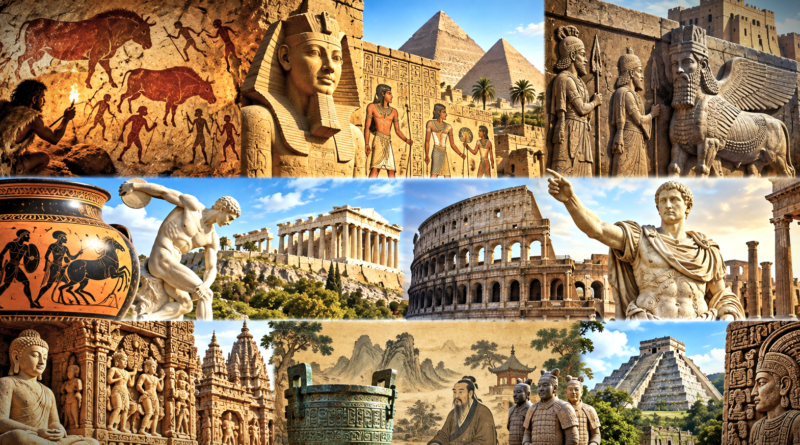
How Ancient Civilizations Used Art to Tell Stories – India Times Group
Discovering How Paintings, Sculptures, Symbols, and Monuments Preserved the History, Beliefs, and Traditions of Ancient Societies
Introduction
Long before books became widely available and written language developed into sophisticated systems, human beings discovered creative ways to share their experiences, beliefs, and memories. They painted animals on cave walls, carved figures into stone, decorated pottery with meaningful patterns, and constructed monuments that reflected their understanding of the world. These artistic creations were much more than objects of beauty. They were powerful storytelling tools that helped ancient civilizations communicate their histories, explain natural events, celebrate rulers, and preserve cultural traditions.
Art allowed people to communicate ideas across generations, including to individuals who had never witnessed the events being represented. A painting of a successful hunt could express courage and cooperation, while a sculpture of a powerful ruler could communicate authority and divine favor. Religious images helped communities understand spiritual beliefs, and scenes of farming, celebrations, and warfare offered glimpses into everyday life.
Although ancient societies developed different artistic styles and traditions, they shared a common desire to make important experiences visible and memorable. Their artwork frequently combined observation, imagination, symbolism, and collective memory.
Today, these surviving creations provide valuable insights into civilizations whose voices might otherwise have disappeared. By studying ancient art, we can explore how people understood their surroundings, organized their societies, and explained their place in the universe.
1. Cave Paintings: The Earliest Visual Stories
Some of humanity’s earliest surviving artistic expressions appear on cave walls and rock surfaces. These images frequently depict animals, human figures, handprints, and abstract markings. Their creators used natural pigments, charcoal, and other materials available in their surroundings.
Animals feature prominently in many prehistoric paintings. Horses, bison, deer, and other creatures appear in compositions that demonstrate careful observation of movement and physical form. These images reveal that early artists paid close attention to the animals sharing their environment.
The precise purpose of these paintings remains uncertain. Some may have been connected to hunting traditions, spiritual beliefs, group ceremonies, or the desire to record significant experiences. It would be misleading to assume that every animal image represented a particular event or religious practice.
Nevertheless, cave paintings show how visual representation could communicate information without written language. A community might recognize an animal, understand its importance, and connect the image with shared experiences.
Handprints and repeated markings may also have helped express human presence and identity. Although their original meanings cannot always be recovered, these images demonstrate an early desire to leave a lasting record.
Cave art therefore represents an important beginning in humanity’s long tradition of telling stories through visual symbols.
2. Ancient Egypt: Art as a Record of Life and the Afterlife
Ancient Egyptian art developed into a highly organized visual language that communicated religious beliefs, royal authority, and social traditions. Temple walls, tomb paintings, statues, and decorated objects presented stories that connected human life with the divine world.
Egyptian artists often arranged figures according to established conventions. Important individuals could appear larger than servants or attendants, emphasizing their social position rather than their actual physical size. Distinctive poses and recognizable symbols helped viewers identify rulers, deities, and different activities.
Tomb paintings frequently depicted farming, fishing, food preparation, music, and other familiar scenes. These images documented everyday practices while also serving religious purposes. In funerary settings, representations of food and daily activities were associated with the belief that the deceased could continue to receive provisions and enjoy an existence beyond death.
Royal monuments communicated another kind of story. Carved reliefs presented pharaohs defeating enemies, participating in ceremonies, and receiving support from the gods. Such scenes reinforced the ruler’s position as a central figure responsible for maintaining order.
Hieroglyphic inscriptions worked alongside pictures to provide names, titles, prayers, and explanations. Rather than functioning as separate forms of communication, writing and imagery often complemented each other.
Through this combination, Egyptian art became a lasting record of religious ideas, political power, and the social world that shaped one of history’s most influential civilizations.
3. Mesopotamia: Carving the Stories of Kings and Gods
Mesopotamia, located between the Tigris and Euphrates rivers, witnessed the development of several early urban civilizations. Their rulers used art to communicate political authority, religious devotion, military achievements, and ideas about the relationship between humans and the gods.
Stone reliefs were especially effective storytelling devices. Artists carved figures into palace walls, arranging people, animals, and supernatural beings into sequences that conveyed recognizable events.
Assyrian palace reliefs, for example, often depicted royal hunting expeditions, military campaigns, and ceremonial activities. Scenes of kings confronting powerful animals portrayed courage, control, and leadership. Military scenes communicated the strength of the kingdom and the ruler’s ability to protect or expand its territory.
These images were not neutral reports of events. They presented carefully constructed accounts intended to influence how viewers understood royal power.
Mesopotamian artists also represented protective supernatural figures. Monumental winged creatures guarded important entrances, symbolically connecting architecture with protection and authority.
Clay tablets and written inscriptions sometimes accompanied artistic representations, identifying rulers or recording victories. In this way, visual storytelling and written history worked together.
Mesopotamian art demonstrates how images could shape political memory. By placing royal achievements on palace walls and monuments, rulers ensured that visitors encountered their preferred version of events.
4. Ancient Greece: Myths, Heroes, and Human Experience
Ancient Greek artists transformed mythology, heroic traditions, and everyday experiences into recognizable visual narratives. Their stories featured gods, warriors, legendary journeys, family conflicts, and the consequences of human decisions.
Pottery became one of the most effective ways to communicate these narratives. Greek vessels were decorated with painted scenes showing mythological encounters, athletic competitions, ceremonies, and activities associated with daily life.
The figures and gestures on these vessels helped viewers identify dramatic moments. A hero facing a monster, a warrior preparing for battle, or a deity interacting with a mortal could communicate an entire episode through a single composition.
Greek sculpture offered another approach. Sculptors represented gods, athletes, and heroes through carefully observed bodies and expressive poses. Their works often emphasized physical movement, confidence, tension, and emotional significance.
Public buildings also carried stories through their decoration. Sculpted architectural panels represented legendary battles and religious processions, connecting civic identity with shared traditions.
Greek visual storytelling was closely associated with oral poetry and theatrical performance. Audiences familiar with traditional myths could recognize characters and understand the broader events suggested by an image.
Artists did not always reproduce the same story in identical ways. Different compositions could emphasize different characters, moments, or interpretations.
Through their art, Greek communities explored courage, pride, loyalty, suffering, and the complicated relationship between human beings and forces beyond their control.
5. Ancient Rome: Art as Public Memory and Political Communication
Roman civilization adopted and adapted artistic traditions from several cultures, including the Greeks and the peoples of the Mediterranean. Roman art became particularly important in presenting military achievements, civic identity, imperial authority, and the lives of prominent individuals.
Monumental sculpture frequently served as a public record of political events. The Column of Trajan, for example, contains a continuous spiral relief depicting episodes associated with the emperor’s military campaigns against Dacia.
Rather than presenting a single isolated moment, the carving unfolds through a sequence of scenes. Soldiers build fortifications, cross difficult terrain, prepare for battle, and participate in military operations. Together, these episodes create a visual account of imperial activity.
Roman triumphal arches also communicated political messages. Their sculptural decorations and inscriptions celebrated victories, commemorated emperors, and presented military success as a source of public pride.
Portraiture played a different role. Sculpted busts and statues preserved the appearances and public identities of rulers, officials, and other important individuals. Such portraits could communicate age, experience, status, or authority.
Domestic art also recorded Roman life. Mosaics and wall paintings depicted gardens, mythological scenes, theatrical performances, landscapes, and familiar activities.
Roman artists therefore used storytelling on several levels. Their works could entertain, preserve memories, decorate private spaces, and promote official interpretations of political events.
6. Ancient India: Art, Spirituality, and Sacred Narratives
Ancient Indian civilizations developed rich artistic traditions that connected spiritual teachings, community life, royal patronage, and cultural memory. Sculptures, stupas, cave paintings, temple decorations, and carved architectural panels helped communicate stories to people across different generations.
Buddhist monuments provide particularly important examples of visual storytelling. At sites such as Sanchi, carved gateways contain scenes associated with the Buddha’s life, previous births, and teachings. Symbolic representations, including the wheel, footprints, and the Bodhi tree, could communicate religious meanings without always depicting the Buddha in human form.
These visual narratives encouraged visitors to reflect on generosity, compassion, wisdom, and the consequences of human actions.
Rock-cut caves also became important spaces for artistic expression. Their painted and sculpted surfaces preserved religious figures, royal patrons, attendants, and scenes inspired by traditional narratives. The surviving paintings at Ajanta, for example, reveal the sophistication of ancient Indian artistic techniques and the importance of storytelling within Buddhist traditions.
Hindu artistic traditions also developed extensive visual vocabularies for representing deities, cosmic events, and stories associated with the Ramayana, Mahabharata, and Puranic literature. Sculptural scenes made complex narratives visible through recognizable figures, gestures, objects, and relationships.
Such works were not simply illustrations. They helped connect religious ideas with public spaces, ceremonies, and collective cultural experience.
Ancient Indian art demonstrates how storytelling could communicate ethical principles and spiritual concepts while preserving the artistic identities of different communities.
7. Ancient China: Art, Ancestors, and Imperial History
Ancient Chinese art developed through traditions that emphasized ancestral relationships, political legitimacy, philosophical ideas, and harmony between human society and the natural world.
Bronze vessels from early Chinese dynasties sometimes carried inscriptions associated with family histories, important events, and royal recognition. Their elaborate decorations also expressed social status and ceremonial significance.
Ancestor worship influenced the creation and use of many objects. Ritual vessels, tomb sculptures, and burial goods reflected beliefs about family continuity and obligations between generations. These objects preserved the memory of individuals while connecting family identity with a broader social order.
Painting gradually became an important medium for communicating historical events, moral lessons, landscapes, and philosophical reflections. Artists could represent officials, scholars, rulers, and legendary figures in compositions that conveyed more than their outward appearance.
Imperial art also helped communicate political legitimacy. Court-sponsored works represented the ruler’s relationship with the state, while historical illustrations could preserve preferred interpretations of important events.
Chinese visual traditions frequently valued symbolic meaning. Particular natural elements, animals, and objects could suggest qualities such as longevity, prosperity, or moral strength, depending on their context.
Through these artistic practices, Chinese societies preserved memories of their ancestors, expressed ideas about responsible government, and explored relationships between people, nature, and the wider universe.
8. The Maya Civilization: Art, Calendars, and Sacred History
The ancient Maya developed sophisticated artistic traditions that combined visual imagery, writing, mathematics, astronomy, and religious thought. Their monuments and painted objects recorded royal events, ceremonial occasions, dynastic histories, and important dates.
Stone stelae frequently depicted rulers wearing elaborate clothing and ceremonial ornaments. Hieroglyphic inscriptions accompanying these figures recorded names, dates, accessions to power, victories, and other significant events.
The combination of images and inscriptions created a structured historical record. A ruler’s portrait communicated authority, while the accompanying text helped identify the person and situate the event within a broader chronology.
Maya artists also decorated pottery with mythological figures, courtly scenes, and supernatural beings. Some painted vessels appear to have been associated with elite ceremonies and burial practices, providing evidence of how art participated in both political and spiritual life.
Architecture contributed to the same visual system. Temples, plazas, and ceremonial buildings organized public space around important religious and political activities.
The Maya understood time through complex calendrical systems, and dates often played a central role in their inscriptions. Recording events within these systems helped connect contemporary rulers with earlier generations and sacred traditions.
Their art reveals a civilization in which storytelling, historical documentation, religious belief, and scientific observation were closely connected.
9. How Symbols Made Stories Understandable
Across ancient civilizations, symbols allowed artists to communicate complex meanings through recognizable images. A single figure or object could suggest a wider story to people familiar with the culture in which it appeared.
Animals, plants, weapons, crowns, and ceremonial objects often carried meanings beyond their physical appearance. A lion might communicate royal power in one context, while a particular bird could represent a deity or spiritual quality in another.
Gestures also helped establish relationships between characters. A raised hand might indicate blessing, authority, greeting, or ritual action, depending on the artistic tradition.
The placement of figures mattered as well. A central character surrounded by attendants could communicate status, while repeated images arranged in sequence could represent the passage of time or the stages of an event.
However, symbols did not possess universally fixed meanings. Their interpretation depended on local traditions, historical circumstances, religious beliefs, and the purpose of the artwork.
Understanding ancient art therefore requires more than identifying what an image depicts. Researchers must also consider where it appeared, who created or commissioned it, who might have viewed it, and how it related to other cultural practices.
This attention to context helps prevent modern viewers from imposing meanings that ancient audiences may never have intended.
10. What Ancient Art Reveals About Everyday Life
Although monuments and royal portraits attract considerable attention, ordinary objects also preserve valuable stories about ancient societies.
Decorated pottery can reveal food traditions, trade relationships, manufacturing techniques, and preferences in household decoration. Jewelry and clothing accessories provide clues about social status, craftsmanship, and personal identity.
Images of musicians, farmers, dancers, merchants, and artisans help researchers investigate activities that written royal histories may overlook.
Burial objects can reveal how communities understood death, family relationships, and the afterlife. Domestic paintings may preserve evidence of architecture, furniture, gardens, and entertainment.
Yet these records must be interpreted carefully. Artwork often reflects the priorities of wealthy patrons, religious institutions, or political authorities rather than representing every member of society equally.
A royal monument might celebrate a military victory without recording the suffering caused by the campaign. A tomb painting might portray an idealized world rather than an ordinary person’s actual experience.
By comparing artistic evidence with archaeological discoveries and other surviving records, researchers can develop a more balanced understanding of ancient life.
Conclusion
Ancient civilizations used art to preserve stories, communicate beliefs, celebrate achievements, and explain the world around them. From prehistoric cave paintings to Egyptian tomb decorations, Greek pottery, Roman monuments, Indian religious sculptures, Chinese ritual objects, and Maya inscriptions, artistic traditions transformed experiences and ideas into lasting visual forms.
These creations served many purposes. They strengthened political authority, supported religious practices, preserved family histories, and communicated cultural values. They also recorded aspects of everyday life that might otherwise have been forgotten.
Although the original meanings of some artworks remain uncertain, their survival allows modern generations to investigate the imagination and experiences of people who lived thousands of years ago.
Ancient art reminds us that storytelling has never depended entirely on written words. Images, symbols, architecture, and objects can communicate powerful ideas across time, especially when communities share the knowledge needed to understand them.
By studying these creations with curiosity and historical care, we gain more than an appreciation of artistic skill. We discover how human beings have continually used creativity to remember their past, make sense of their present, and pass their stories to the future.