
The Evolution of Indian Agriculture: From Traditional Farming to Modern Methods – India Times Group
How Changing Farming Practices, Scientific Innovations, and Modern Technology Are Transforming India’s Agricultural Landscape
Introduction
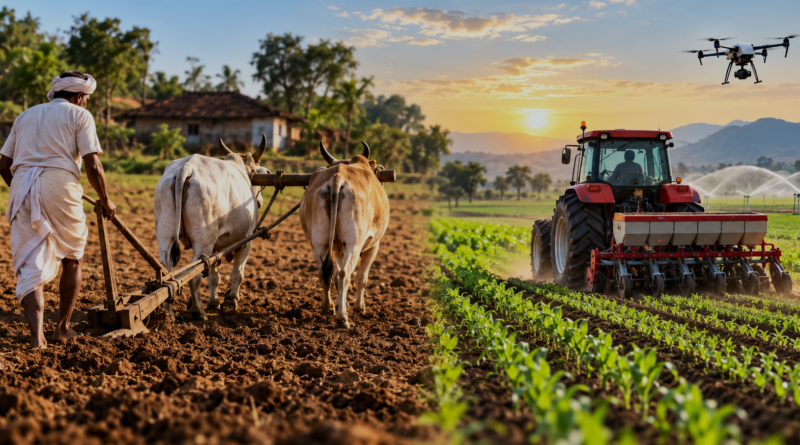
Agriculture has been an essential part of Indian civilization for thousands of years. It has shaped the country’s economy, influenced its culture, supported rural communities, and provided livelihoods to millions of families. From traditional farmers using wooden ploughs and bullocks to modern agriculturalists operating tractors, drones, and automated irrigation systems, Indian agriculture has experienced remarkable changes over time. These developments reflect the country’s efforts to increase food production, improve farmers’ incomes, and meet the demands of a growing population.
In earlier times, farming depended heavily on natural rainfall, traditional knowledge, family labour, and locally available resources. Farmers followed practices passed down through generations, selecting seeds according to regional climates and cultivating crops suited to their land. Although these methods often supported sustainable relationships with nature, limited technology and unpredictable weather frequently restricted agricultural productivity.
Today, Indian agriculture is undergoing another transformation. Improved seeds, scientific farming techniques, digital technologies, modern machinery, and advanced irrigation systems are changing how crops are cultivated and harvested. However, challenges such as small landholdings, rising production costs, water scarcity, and climate change continue to affect farmers. Understanding the evolution of Indian agriculture helps explain both its achievements and the changes required for a more productive and sustainable future.
1. Traditional Agriculture in Ancient India
Traditional agriculture formed the foundation of India’s rural economy. Early communities gradually developed farming techniques that allowed them to grow grains, vegetables, pulses, and other crops for their families and local settlements. Over time, agricultural knowledge became closely connected with regional geography, seasonal rainfall, soil conditions, and cultural practices.
Farmers generally used simple tools, including wooden ploughs, sickles, hoes, and other manually operated implements. Bullocks and other draft animals provided power for ploughing fields and transporting agricultural produce. Seeds were often preserved from previous harvests, allowing farmers to maintain crop varieties adapted to their local environments.
Traditional Indian agriculture was diverse. Rice cultivation became important in regions with sufficient water, while wheat and other grains were widely cultivated in areas with suitable climates. Millets and pulses played significant roles in relatively dry regions. Cotton, sugarcane, spices, and oilseeds also contributed to local economies and trade.
Water management was another important feature of traditional farming. Communities developed wells, tanks, ponds, canals, and other irrigation structures according to local requirements. In many places, collective management helped distribute water and maintain agricultural resources.
Farmers also relied on organic materials such as animal manure, compost, and crop residues to maintain soil fertility. Crop rotation and mixed cultivation were practised in different regions, although methods varied considerably.
Despite these achievements, traditional agriculture faced limitations. Production depended heavily on weather conditions, while inadequate irrigation and limited access to improved tools made it difficult to increase yields consistently. Droughts, floods, pests, and crop diseases could threaten household food supplies.
2. Agriculture During the Medieval Period
During the medieval period, Indian agriculture continued to develop through regional innovations, changing land management systems, and expanding trade. Farming remained the primary occupation for much of the population, supporting villages, towns, and ruling administrations.
Different kingdoms and local communities developed agricultural practices suited to their territories. Irrigation tanks, wells, canals, and reservoirs supported cultivation in several regions. Farmers grew food crops alongside commercial crops, supplying both household needs and markets.
The expansion of trade increased the importance of products such as cotton, sugarcane, indigo, spices, and other valuable agricultural commodities. These crops provided raw materials for crafts and contributed to regional commerce.
Agricultural production was also influenced by land revenue systems. Governments and local authorities collected a share of agricultural output or assessed taxes on cultivated land. Such arrangements affected farmers’ economic security, especially when harvests were poor.
Traditional farming knowledge continued to evolve through experience. Farmers adjusted planting schedules, selected suitable crop varieties, and developed methods for managing local water supplies. Knowledge was commonly shared within families and communities rather than through formal agricultural institutions.
Nevertheless, productivity remained restricted by limited mechanisation, uneven irrigation facilities, and vulnerability to environmental conditions. Agricultural improvements occurred gradually, and their benefits differed significantly across regions.
3. Colonial Rule and Its Impact on Indian Agriculture
The arrival and expansion of British colonial rule brought major changes to India’s agricultural economy. Revenue policies, commercial priorities, and new patterns of trade influenced what farmers cultivated and how agricultural land was managed.
In several regions, farmers were encouraged or compelled by economic and administrative pressures to produce commercial crops. Cotton, indigo, jute, tea, and other commodities became increasingly important in colonial trade. Although commercial agriculture created new market opportunities, it also exposed cultivators to price fluctuations and changing demand.
Land revenue arrangements placed substantial financial pressure on many farming households. Farmers could struggle to meet tax obligations when harvests failed or market prices declined. In some circumstances, dependence on moneylenders increased, leaving families vulnerable to debt.
Colonial agricultural development was uneven. Certain plantations and commercially important areas received investment in transport and irrigation, but widespread access to scientific farming, improved seeds, and modern equipment remained limited.
Railways and expanding market connections changed how agricultural produce moved across the country. However, improved transportation did not automatically ensure fair prices or financial security for cultivators.
The colonial period demonstrated that agricultural progress depends not only on cultivation techniques but also on land rights, market access, public investment, and the economic conditions under which farmers operate.
4. Agriculture After Independence
When India gained independence in 1947, agriculture faced serious challenges. Food production was insufficient to meet the needs of the population consistently, agricultural productivity was low in many areas, and irrigation and rural infrastructure required significant improvement.
The government began prioritising agricultural development through irrigation projects, agricultural research, rural development programmes, and institutional support. Large dams and canal networks were developed in several regions to increase the availability of water for cultivation.
Agricultural universities and research institutions contributed to the development of improved crop varieties and scientific farming methods. Extension services gradually helped introduce farmers to better cultivation practices, pest management, fertiliser application, and soil improvement.
Land reforms were also pursued in different states, although their implementation and outcomes varied. Cooperative institutions and agricultural credit programmes aimed to improve farmers’ access to resources.
The development of community programmes and rural infrastructure created a foundation for later agricultural modernisation. However, progress remained uneven because farmers differed in their access to irrigation, finance, education, technology, and markets.
India needed a more substantial increase in agricultural productivity to reduce dependence on imported food grains and strengthen national food security. This need contributed to one of the most important transformations in the country’s farming history: the Green Revolution.
5. The Green Revolution and Higher Food Production
The Green Revolution marked a major turning point in Indian agriculture during the 1960s and 1970s. It introduced a package of agricultural innovations designed to increase the production of important food grains, particularly wheat and rice.
High-yielding crop varieties played a central role. When combined with irrigation, chemical fertilisers, crop protection products, and improved cultivation practices, these varieties enabled farmers in suitable regions to produce significantly larger harvests.
Punjab, Haryana, and parts of western Uttar Pradesh became prominent centres of this transformation. Agricultural machinery, improved seeds, irrigation infrastructure, and government procurement arrangements supported increased production in these areas.
The Green Revolution strengthened India’s capacity to supply food grains to its population. Higher output helped improve food availability and reduced vulnerability to some forms of agricultural shortage.
However, its benefits were not distributed equally. Regions lacking reliable irrigation or access to agricultural inputs often experienced slower progress. Larger and better-resourced farmers were generally better positioned to adopt the new technologies.
The intensive use of water, fertilisers, and pesticides also created environmental concerns. Groundwater depletion, soil degradation, chemical pollution, and reduced crop diversity became important issues in certain farming regions.
The Green Revolution demonstrated the potential of scientific agriculture while highlighting the importance of balancing productivity with environmental protection.
6. Mechanisation: From Animal Power to Modern Machinery
Agricultural mechanisation has significantly changed how Indian farmers prepare fields, sow seeds, manage crops, and harvest produce.
Traditionally, farmers relied on human labour and animal power for most field operations. These methods remain useful in some areas, especially where fields are small, steep, or difficult for large machines to access. However, increasing labour costs and the need to complete agricultural operations within narrow seasonal windows have encouraged the adoption of machinery.
Tractors have become important tools for ploughing, land preparation, and transporting agricultural materials. Seed drills help place seeds at more consistent depths and spacing. Harvesters and threshers can reduce the time required to collect crops and separate grains.
Modern machinery can improve operational efficiency, reduce certain forms of manual labour, and help farmers manage larger workloads. Timely sowing and harvesting can also reduce losses associated with unfavourable weather.
Nevertheless, purchasing equipment remains expensive for many small farmers. Custom hiring centres, machinery rental services, and farmer cooperatives can help address this problem by allowing cultivators to use equipment without bearing its full purchase cost.
Mechanisation in India is therefore moving towards a combination of individual ownership, shared services, and specialised machinery suited to different farm sizes.
7. Modern Seeds, Fertilisers, and Crop Protection
Scientific developments in seed technology have created new opportunities for Indian agriculture. Improved varieties can offer higher yields, better resistance to particular diseases, earlier maturity, or greater suitability for specific environmental conditions.
Hybrid seeds are used in several crops, while conventional breeding continues to improve important food grains, pulses, oilseeds, and other agricultural products. The selection of suitable seeds depends on local climate, soil characteristics, water availability, and market demand.
Chemical fertilisers have helped increase crop productivity by supplying nutrients required for plant growth. However, excessive or unbalanced application can harm soil health and contribute to environmental pollution. Integrated nutrient management combines suitable fertilisers with compost, manure, crop residues, and other sources of plant nutrients.
Crop protection has also advanced. Farmers use improved monitoring techniques and pest management practices to reduce damage from insects, weeds, and diseases. Integrated pest management encourages the combination of biological controls, cultural methods, resistant varieties, and carefully selected pesticides when necessary.
The future of agricultural inputs depends on using them efficiently rather than simply increasing their quantity. Soil testing, balanced nutrition, quality seeds, and responsible crop protection can help farmers improve productivity while reducing unnecessary expenditure.
8. Irrigation and Water Management Innovations
Water availability has always influenced agricultural success in India. Traditional cultivation depended heavily on seasonal rainfall, but modern irrigation has allowed farmers in many regions to cultivate crops more reliably.
Canals, reservoirs, tube wells, and pumps have expanded irrigation facilities. However, excessive groundwater extraction has created serious concerns in areas where water consumption exceeds natural replenishment.
Modern irrigation methods, including drip and sprinkler systems, can improve water-use efficiency when appropriately designed and maintained. Drip irrigation delivers water close to plant roots, while sprinkler systems distribute water across fields through controlled spraying.
Rainwater harvesting, farm ponds, watershed development, and groundwater recharge can further support agricultural water management. Farmers can also adjust sowing schedules and select crops according to local water availability.
Water-efficient agriculture is especially important as rainfall patterns become less predictable. Combining modern irrigation with careful crop planning can help protect both farm productivity and valuable water resources.
9. Digital Agriculture and Smart Farming
Digital technology represents a new stage in the evolution of Indian agriculture. Smartphones, satellite imagery, sensors, weather forecasting, and data-based decision-making are creating opportunities to manage farms more precisely.
Farmers can access weather information, market prices, cultivation guidance, and agricultural advisories through digital platforms. Such information can help them decide when to sow seeds, apply irrigation, manage pests, and sell produce.
Satellite imagery and remote sensing can assist in monitoring crop conditions across large areas. Soil sensors can measure moisture levels, supporting more efficient irrigation. Artificial intelligence can help analyse agricultural data, identify possible crop diseases, and improve forecasts, although its usefulness depends on reliable data and appropriate local application.
Drones are also being explored for crop monitoring, field mapping, and certain agricultural spraying operations. Their practical value depends on cost, regulation, operator training, and suitability for individual farms.
Despite these developments, digital agriculture faces challenges. Internet access, digital literacy, language barriers, equipment costs, and the reliability of online information can limit adoption.
For technology to benefit farmers widely, digital services must be affordable, accessible in local languages, and supported by practical agricultural training.
10. Organic Farming and Sustainable Agriculture
Modern agriculture increasingly recognises that higher production must be accompanied by environmental responsibility. Sustainable farming seeks to maintain productivity while protecting soil, water, biodiversity, and the long-term health of agricultural ecosystems.
Organic farming relies on practices such as composting, crop rotation, green manuring, biological pest management, and the use of permitted organic inputs. It aims to reduce dependence on synthetic fertilisers and pesticides, although successful production requires careful nutrient and pest management.
Natural farming approaches emphasise ecological processes and locally available resources. Conservation agriculture promotes practices such as reduced soil disturbance, permanent soil cover, and crop diversification where appropriate.
Integrated farming systems combine activities such as crop cultivation, livestock rearing, horticulture, fisheries, and agroforestry. Such diversification can create additional income opportunities and improve the use of farm resources.
Sustainable agriculture is not identical everywhere. A practice suitable for one region may be unsuitable for another because of differences in rainfall, soil, crop types, and market access.
The central objective is to develop farming systems that remain productive over time without exhausting the natural resources on which agriculture depends.
11. Major Challenges Facing Modern Indian Agriculture
Despite considerable progress, Indian agriculture continues to face several interconnected challenges.
Small and fragmented landholdings make mechanisation, irrigation investment, and efficient resource management difficult for many cultivators. Limited access to affordable credit can prevent farmers from purchasing quality inputs or adopting improved technologies.
Market uncertainty is another concern. Prices can fluctuate considerably, while transportation, storage, and processing limitations may reduce the returns farmers receive for their produce.
Climate change adds further pressure through changing rainfall patterns, heat stress, droughts, floods, and emerging pest and disease risks. Farmers growing water-intensive crops in vulnerable regions may face particularly difficult decisions.
Post-harvest losses remain a concern where cold storage, grading, processing, and transportation facilities are inadequate. Better infrastructure can help preserve produce quality and connect farmers with more valuable markets.
Agricultural education and extension services are equally important. New technology produces limited benefits when farmers cannot obtain reliable guidance about its use, cost, or suitability.
Addressing these challenges requires coordinated efforts involving farmers, researchers, governments, cooperatives, financial institutions, and private enterprises.
12. The Future of Indian Agriculture
The future of Indian agriculture will depend on combining scientific innovation with the experience and knowledge of farming communities. Technology alone cannot solve every agricultural problem, but appropriate innovations can make farming more efficient, resilient, and profitable.
Climate-resilient crop varieties, efficient irrigation, renewable energy, improved storage, and digital advisory services can strengthen agricultural systems. Better access to markets and food-processing facilities can help farmers capture more value from their produce.
Crop diversification also deserves attention. Depending on regional conditions, millets, pulses, oilseeds, fruits, vegetables, and other suitable crops can provide alternatives to intensive dependence on a limited number of grains.
Farmer producer organisations and cooperatives can improve bargaining power by helping cultivators purchase inputs, share equipment, aggregate produce, and negotiate with buyers.
Investment in agricultural research, rural education, and skill development will remain essential. Women farmers, tenant cultivators, and smallholders must also be able to access relevant training, finance, technology, and institutional support.
A successful agricultural future will not be measured by production figures alone. It will also depend on farmers’ incomes, food quality, environmental sustainability, and the resilience of rural communities.
Conclusion
The evolution of Indian agriculture reflects a long journey from traditional cultivation methods to increasingly scientific, mechanised, and technology-driven farming systems. Ancient communities developed valuable agricultural knowledge, medieval societies expanded regional cultivation practices, and colonial policies reshaped agricultural markets. After independence, irrigation projects, agricultural research, and the Green Revolution strengthened India’s food production capacity.
Today, modern machinery, improved seeds, digital tools, efficient irrigation, and sustainable farming practices are creating new opportunities. At the same time, farmers continue to confront financial pressures, climate uncertainty, uneven infrastructure, and environmental challenges.
The next stage of agricultural development must combine innovation with accessibility and ecological responsibility. Farmers need affordable technology, reliable markets, practical education, and policies that support long-term productivity. By building on traditional knowledge while adopting appropriate modern methods, India can create an agricultural system that supports food security, strengthens rural livelihoods, and protects natural resources for future generations.