
Warli Art: The Beauty of Tribal Storytelling – India Times Group
Introduction
India’s cultural heritage is a remarkable collection of artistic traditions, each reflecting the beliefs, experiences, and creativity of its people. Among these traditions, Warli art holds a special place because of its simplicity, symbolism, and deep connection with everyday life. Originating among the Warli tribal community of Maharashtra, this traditional art form transforms ordinary scenes into meaningful visual stories. Through simple geometric shapes, earthy colors, and rhythmic patterns, Warli artists portray the relationship between human beings, nature, animals, and the spiritual world.
Unlike many art forms that depend on elaborate colors or detailed representations, Warli painting communicates through minimal lines and shapes. Circles, triangles, squares, and straight lines become people, trees, houses, animals, and entire communities. These figures may appear simple at first glance, but together they express complex ideas about cooperation, celebration, agriculture, family, and the natural environment.
Warli art is not merely a decorative tradition. It is a visual record of community life and a creative expression of cultural identity. Its continuing popularity demonstrates how an ancient artistic practice can remain meaningful in a rapidly changing world.
The Origins and Historical Background of Warli Art
Warli art is associated with the Warli tribal community, traditionally found in parts of Maharashtra, particularly the northern coastal region and areas near the Maharashtra-Gujarat border. Communities in this region developed artistic practices closely connected to their surroundings, livelihoods, ceremonies, and beliefs.
The exact beginnings of Warli painting are difficult to establish because the tradition was transmitted primarily through practice and oral knowledge rather than written records. Its historical development is connected with rural life, agricultural cycles, household rituals, and the shared experiences of tribal communities.
For generations, Warli paintings were created on the walls of houses, especially during weddings and other significant occasions. Women played an important role in preserving and practising this tradition. Painting was often a collective activity through which artistic knowledge passed from older generations to younger members of the community.
The walls of traditional homes provided more than a surface for decoration. They became spaces where people expressed hopes for prosperity, celebrated important transitions, and represented their relationship with nature. Images of farming, dancing, animals, and village life reflected the experiences that shaped the community.
Warli art gained wider recognition during the twentieth century as artists began transferring traditional designs onto paper, canvas, and other materials. This development helped the art reach audiences beyond its original cultural setting. Although its presentation has changed, the tradition continues to draw inspiration from the community’s environment and collective memory.
The Distinctive Visual Language of Warli Painting
One of the most recognizable features of Warli art is its limited visual vocabulary. Artists use basic geometric forms to represent people and objects, creating compositions that are easy to recognize while allowing considerable artistic expression.
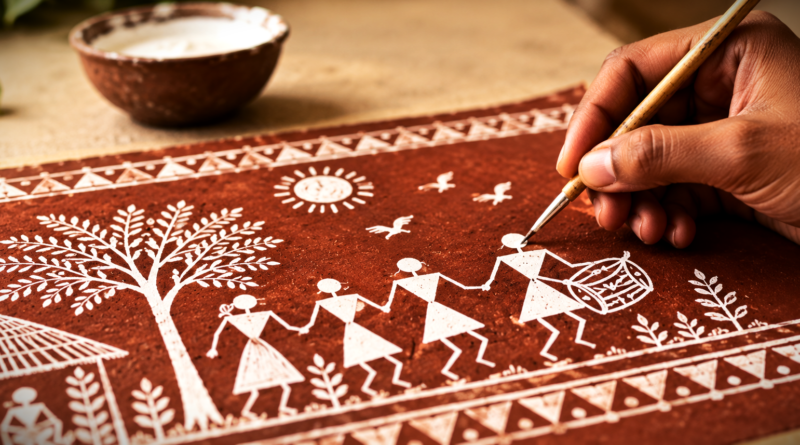
Human figures are commonly constructed from two triangles joined at their points, with lines forming the arms and legs. These figures can be arranged to show walking, working, celebrating, carrying objects, or participating in ceremonies. Their movements create a sense of rhythm across the painting.
Circles frequently represent the sun, moon, or other elements associated with natural cycles. Triangles may suggest mountains, trees, or human bodies, depending on the composition. Squares often represent enclosed or sacred spaces, including areas associated with rituals and community gatherings.
The simplicity of these shapes allows artists to focus on relationships rather than individual physical details. A group of figures arranged in a circle can communicate collective participation, while repeated lines of dancers suggest unity and celebration.
Warli paintings often avoid realistic perspective. Instead of creating the illusion of depth through shading and proportion, artists organize figures across a surface according to their importance and relationship to the story. This approach gives the artwork a distinctive visual rhythm.
Every line contributes to the larger composition. A small change in the direction of a figure can suggest movement, while repeated patterns can create balance. Through these basic elements, Warli artists demonstrate that artistic communication does not require elaborate techniques.
Natural Materials and the Traditional Color Palette
Traditional Warli painting is closely associated with natural materials and earthy colors. The characteristic combination of white figures against a reddish-brown background creates a striking contrast that makes the images immediately recognizable.
In traditional settings, walls were prepared using materials such as mud and cow dung. The resulting surface provided an earthy background for the painting. White pigment was commonly prepared from rice paste mixed with water and a natural binding material. Bamboo sticks, sometimes chewed at the end to create a brush-like tip, served as simple painting tools.
These materials reflect the community’s close relationship with its environment. Artists used resources available in their surroundings rather than relying on expensive or manufactured supplies.
The restricted palette also contributes to the art’s distinctive appearance. White figures stand out clearly against dark backgrounds, allowing patterns and movements to remain visible even when the individual shapes are very small.
Contemporary Warli artists may use acrylic paints, commercial brushes, canvas, paper, fabric, and other modern materials. Some experiment with additional colors while maintaining traditional geometric figures and storytelling patterns.
Such changes demonstrate the adaptability of the tradition. Materials may evolve, but the visual language can remain recognizable when artists continue to respect its defining characteristics.
Nature at the Heart of Warli Art
Nature is one of the most important themes in Warli painting. Trees, birds, animals, fields, rivers, and the changing seasons appear frequently because the traditional life of the community has been closely connected with the natural environment.
Agriculture has influenced many of the subjects represented in Warli compositions. Scenes of sowing, harvesting, ploughing, and gathering crops reflect the importance of farming in village life. These images also communicate the cooperation required to complete agricultural activities.
Trees are often depicted using simplified branches and geometric patterns. Their presence may represent the surrounding landscape, provide structure to a composition, or connect different scenes within the same painting. Animals and birds add movement and help establish the relationship between people and their environment.
Nature in Warli art is not simply a background against which human activities take place. It is an active part of the story. People depend on the land for food, animals contribute to rural livelihoods, and seasonal changes influence work and celebrations.
This relationship gives Warli painting a continuing relevance in contemporary discussions about environmental awareness. The artwork encourages viewers to consider how communities depend on natural resources and how human activities form part of larger ecological systems.
However, Warli art should not be reduced to a modern environmental message alone. Its relationship with nature emerges from the community’s lived experiences, cultural practices, and traditional worldview.
The Tarpa Dance: A Celebration of Community
Among the best-known subjects in Warli art is the Tarpa dance, a communal dance traditionally associated with a wind instrument called the tarpa. During the dance, participants form a circle or spiral around the musician, following the rhythm and movements of the performance.
In paintings, the dance is often represented through a series of small human figures holding hands. Their bodies lean in different directions, creating the impression of continuous movement. The circular arrangement brings the figures together and gives the composition a strong sense of unity.
The Tarpa dance is significant because it represents more than entertainment. It illustrates collective participation, shared cultural identity, and the importance of gathering together. The dancers are individual figures, yet their arrangement makes them part of a larger whole.
Artists may include musicians, trees, animals, and village surroundings to provide additional context. Even with limited details, the viewer can understand the atmosphere of celebration.
The dance also demonstrates the effectiveness of repetition in Warli art. Repeated figures establish rhythm in much the same way that repeated musical beats support a performance. The visual pattern becomes a record of sound and movement.
For this reason, the Tarpa dance remains one of the most recognizable examples of Warli storytelling and a powerful expression of community life.
Rituals, Beliefs, and the Spiritual Dimension
Warli art has traditionally been connected with important social and ceremonial occasions. Marriage rituals, seasonal celebrations, and other community events have provided opportunities for painting and collective artistic activity.
Certain traditional compositions include sacred motifs and figures associated with fertility, prosperity, and the continuity of life. Their meanings depend on the cultural context in which they are created and used.
One important motif in traditional Warli painting is the chauk, a square-shaped composition that can mark a sacred or ritual space. Variations of this design may be associated with ceremonial practices and figures connected with the community’s spiritual traditions.
The presence of a square within a larger painting demonstrates how geometry can carry meaning beyond visual decoration. Its boundaries distinguish a particular area from the surrounding scene, giving the composition a sense of focus and significance.
Warli art also reflects the close relationship between everyday life and spiritual belief. Agriculture, marriage, family, and community celebrations are not necessarily treated as separate from the sacred. Instead, these activities can form part of a broader understanding of life and its cycles.
It is important to recognize that meanings can vary between communities, artists, and occasions. Warli painting is a living tradition rather than a fixed collection of symbols with identical interpretations everywhere.
Everyday Life as a Visual Story
A major strength of Warli art is its ability to turn ordinary activities into memorable images. Scenes of people carrying water, tending animals, preparing food, building homes, or working in fields appear simple but communicate the structure of rural life.
These subjects make Warli painting a valuable form of cultural storytelling. The paintings record activities that may otherwise remain absent from formal historical accounts. Instead of focusing only on rulers, monuments, or major political events, Warli artists give attention to families, workers, farmers, and community gatherings.
The repeated appearance of groups also highlights the importance of cooperation. Several figures working together can represent shared responsibility, while scenes of celebrations reveal how social relationships strengthen community life.
The paintings do not necessarily describe one specific event. Often, they present familiar activities as patterns that represent a broader way of living. A field full of workers, for example, can express the importance of agriculture without identifying a particular village or season.
This approach gives Warli art both local meaning and wider appeal. Viewers from different backgrounds can recognize familiar human experiences while learning about the particular traditions of the Warli community.
Women and the Transmission of Artistic Knowledge
Women have historically played a central role in creating and preserving Warli painting, especially within domestic and ceremonial settings. Their work has helped maintain the visual tradition and transmit its techniques across generations.
Learning often took place through observation and participation. Younger members of a family could watch experienced artists prepare surfaces, mix pigments, draw figures, and arrange patterns. Over time, they learned how to reproduce familiar motifs and develop their own compositions.
This form of learning demonstrates that cultural knowledge does not always depend on formal classrooms or written manuals. Practical experience, shared work, and community participation can be equally important in maintaining artistic traditions.
As Warli art entered commercial markets, women and men increasingly found opportunities to create paintings for buyers, exhibitions, workshops, and cultural programmes. These opportunities have helped bring greater visibility to the artists behind the tradition.
Nevertheless, wider recognition does not automatically guarantee fair income or equal opportunities. Artists benefit when buyers, galleries, cultural institutions, and businesses acknowledge their contributions and provide appropriate compensation.
Supporting Warli artists means valuing not only the finished artwork but also the knowledge, labour, and cultural experience that make it possible.
Warli Art in the Modern World
Warli art has expanded beyond the walls of traditional homes and now appears on canvas, paper, textiles, household products, public installations, and contemporary design projects.
Its geometric forms are particularly adaptable to different surfaces. A small composition can fit on a notebook cover, while a large mural can represent an entire village scene. Artists can preserve the traditional white-on-earthy-background appearance or experiment with new colors and materials.
Designers have also drawn inspiration from Warli motifs for clothing, accessories, packaging, and interior decoration. This visibility introduces the art to new audiences and creates opportunities for artists to reach markets outside their local communities.
However, commercial adaptation also raises important questions. When traditional motifs are reproduced without permission, context, or acknowledgement, the people who developed and preserved the tradition may receive little benefit.
Responsible use involves learning about the art’s origins, identifying and crediting artists, respecting cultural significance, and avoiding the assumption that every traditional design is simply an unrestricted decorative pattern.
Contemporary Warli artists can also explore new themes, including education, public health, urbanization, changing livelihoods, and social challenges. Such subjects demonstrate that the tradition is capable of addressing present-day experiences without abandoning its characteristic visual language.
The balance between innovation and cultural continuity remains an important part of Warli art’s future.
The Difference Between Simplicity and Artistic Skill
Warli painting can appear easy to imitate because it uses basic shapes and a limited color palette. Yet creating a compelling composition requires careful observation, coordination, and an understanding of visual rhythm.
Artists must decide how figures will be arranged, how movement will travel across the surface, and how individual scenes will connect. Too many figures can make a painting crowded, while too few may leave the story incomplete.
Consistency is also important. Repeated shapes must remain visually balanced, and the direction of lines can influence the sense of movement. Small variations in spacing or placement can change the entire composition.
The absence of elaborate shading places greater emphasis on arrangement and proportion. Every figure must contribute to the overall design, whether it represents a dancer, farmer, animal, tree, or musician.
This demonstrates a broader principle of art: technical complexity and artistic value are not the same thing. A work can communicate powerful ideas through a small number of carefully selected elements.
Warli artists use restraint as a creative strength. By removing unnecessary detail, they direct attention toward action, relationships, and the shared experiences represented in the painting.
Preserving Warli Art for Future Generations
The continued survival of Warli art depends on more than its popularity in galleries or shops. It also requires support for the communities and artists who maintain the tradition.
Educational programmes, cultural exhibitions, artist-led workshops, and community initiatives can introduce younger generations to Warli techniques and history. These activities are most valuable when Warli artists participate directly in explaining their own work and experiences.
Fair commercial opportunities can also encourage artists to continue practising their craft. Transparent pricing, appropriate credit, and respectful collaboration help ensure that the economic benefits of cultural recognition reach the people responsible for preserving the art.
Digital platforms offer additional possibilities. Artists can share their work with wider audiences, document techniques, and connect with potential buyers. At the same time, digital circulation makes it important to acknowledge authorship and avoid copying designs without permission.
Museums and cultural institutions can contribute by presenting Warli painting within its social and historical context rather than displaying it solely as an attractive decorative style.
Preservation should not mean preventing change. A living tradition must have room to develop according to the experiences and creative choices of its practitioners. The goal is to ensure that innovation strengthens rather than erases the cultural identity associated with the art.
Conclusion
Warli art demonstrates how a simple visual language can preserve rich cultural experiences. Through geometric figures, earthy backgrounds, and rhythmic arrangements, it portrays agriculture, celebrations, nature, family life, and spiritual traditions. Its paintings reveal a world in which individual activities are closely connected with community relationships and the surrounding environment.
The tradition’s beauty lies not only in its distinctive appearance but also in the stories it carries. Each composition can preserve memories of work, celebration, belief, and cooperation while reflecting the creativity of the people who produce it.
As Warli art reaches contemporary audiences through exhibitions, textiles, murals, and modern design, it continues to evolve. Its future depends on respecting the cultural knowledge behind the images, supporting artists fairly, and allowing new generations to contribute their own ideas.
Ultimately, Warli art reminds us that storytelling does not always require words. A circle of dancers, a line of farmers, or a tree surrounded by people can express relationships and values that connect generations. In its elegant simplicity, Warli painting remains a meaningful expression of tribal creativity and an enduring part of India’s diverse cultural heritage.