
Pattachitra Art: A Traditional Indian Painting Style – India Times Group
Introduction
India is home to a remarkable variety of traditional art forms that reflect its history, spirituality, regional identities, and creative traditions. Among these treasures, Pattachitra holds a special place for its intricate lines, vibrant colours, mythological storytelling, and distinctive decorative patterns. Originating primarily in Odisha and West Bengal, Pattachitra is a traditional painting style that transforms simple surfaces into detailed visual narratives inspired by religious beliefs, folklore, nature, and everyday cultural life.
The word Pattachitra comes from two Sanskrit-derived terms: patta, meaning cloth or a prepared surface, and chitra, meaning picture or painting. Together, they describe paintings created on specially prepared materials, traditionally cloth, using carefully controlled brushwork and natural-looking colours. Although the artistic traditions of Odisha and Bengal share this name, they have developed different techniques, subjects, and visual characteristics.
Pattachitra is more than a decorative art form. It represents generations of artistic knowledge passed from one generation to another through family workshops, apprenticeships, and community traditions. Artists preserve stories of deities, sacred places, historical beliefs, and regional customs through carefully arranged figures and elaborate borders.
In the modern world, Pattachitra continues to attract attention from collectors, cultural institutions, designers, and art enthusiasts. Its survival demonstrates how traditional craftsmanship can retain its identity while adapting to changing artistic interests and contemporary markets.
The Historical Origins of Pattachitra
The history of Pattachitra is closely connected with the religious and cultural traditions of eastern India. Odisha, particularly the region surrounding Puri, became an important centre for paintings associated with the worship of Lord Jagannath. Temple traditions, pilgrimage activities, and religious storytelling helped create an environment in which visual art played an essential role.
For generations, artists created devotional paintings that allowed worshippers to experience sacred narratives beyond the immediate setting of a temple. These works depicted deities, religious episodes, and symbolic scenes using a highly organised visual language.
Pattachitra’s historical development cannot be attributed to a single artist or a precisely defined starting point. Instead, it emerged through the gradual evolution of local painting practices, religious customs, and specialised craft knowledge.
The tradition of Odisha is particularly associated with the Jagannath temple culture of Puri. When the temple’s principal wooden deities undergo the ritual period of Anasara, traditionally associated with their temporary absence from public viewing, painted representations known as Anasara Pati have an important ceremonial role.
In Bengal, Patachitra developed distinctive storytelling traditions associated with itinerant painters and performers known as patuas. These artists often created long painted scrolls and presented their stories through songs and spoken narratives.
Although the two traditions share related terminology and an emphasis on storytelling, they should not be treated as identical. Each has developed its own techniques, subjects, and regional identity.
Pattachitra of Odisha: A Devotional Artistic Tradition
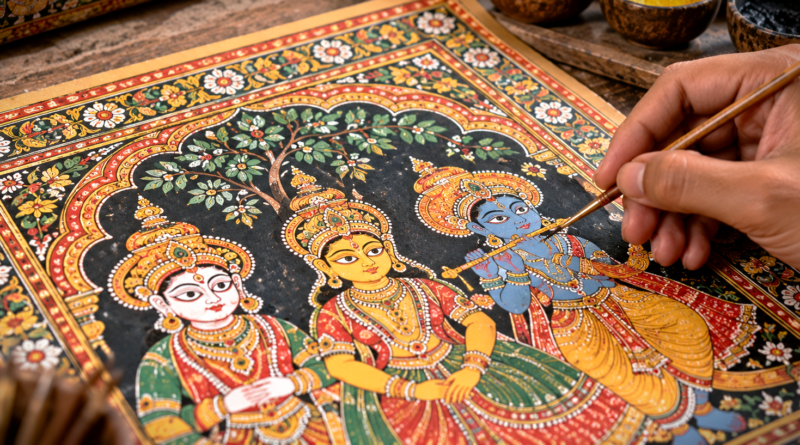
Odisha’s Pattachitra is widely recognised for its precise outlines, elaborate ornamentation, rich colours, and carefully balanced compositions. The paintings frequently feature Hindu deities, particularly Lord Jagannath, Lord Balabhadra, and Goddess Subhadra, alongside episodes from the lives of Krishna and other mythological figures.
Artists organise their subjects within clearly defined spaces, using decorative borders to frame the central narrative. Figures often appear in expressive poses, with prominent eyes, stylised facial features, and richly decorated clothing.
The artwork combines religious significance with extraordinary technical discipline. Even small details, such as jewellery, floral motifs, crowns, and architectural patterns, are rendered with attention to symmetry and visual rhythm.
One important characteristic of Odisha Pattachitra is its ability to communicate complex stories through a relatively flat pictorial space. Rather than depending on modern linear perspective, artists use overlapping figures, symbolic placement, and carefully controlled proportions to establish relationships between characters and events.
The resulting compositions are visually rich yet organised, allowing viewers to recognise important figures and understand the narrative.
Traditional Pattachitra artists, often belonging to hereditary artisan communities, have preserved this distinctive style through generations of practice. Their work connects religious devotion with the cultural identity of Odisha.
Bengal Patachitra: Stories Through Painted Scrolls
Bengal’s Patachitra tradition is especially known for its narrative scrolls, which combine painting with performance. The artists, called patuas, traditionally travelled between villages, displaying painted scenes while singing stories associated with their images.
These performances transformed painting into a shared cultural experience. Viewers could follow a narrative through successive sections of a scroll while listening to the accompanying song.
The subject matter varies considerably. Traditional scrolls may portray episodes from Hindu mythology, stories associated with local deities, folk legends, historical events, and moral lessons. Some contemporary artists also address environmental concerns, public health, social change, and other present-day issues.
Bengal Patachitra is distinguished by its sequential storytelling, expressive figures, and bold visual organisation. Depending on the region and artist, compositions may feature strong outlines, bright colours, decorative motifs, and carefully arranged scenes.
Unlike Odisha’s Pattachitra, which is strongly associated with prepared cloth paintings and temple-related imagery, Bengal’s scroll tradition often emphasises the relationship between images, songs, and oral performance.
Both traditions demonstrate the power of visual storytelling, but their differences reveal the cultural diversity of India’s regional art forms.
Traditional Materials Used in Pattachitra
The creation of traditional Pattachitra involves careful preparation of the painting surface, pigments, brushes, and other materials. These processes require patience and considerable technical knowledge.
1. Prepared Cloth
In Odisha, artists traditionally use a prepared cloth surface called patta. The cloth is treated with a mixture of chalk-like material and an adhesive traditionally made from natural ingredients.
Once the coating has been applied and dried, the surface is polished to create a smooth foundation suitable for detailed painting. This preparation allows artists to control fine lines and apply colour evenly.
2. Natural Pigments
Traditional artists have used pigments obtained from minerals, plants, and other natural materials. Different ingredients produce distinctive shades, including red, yellow, black, white, blue, and green.
The exact materials and recipes vary between workshops and regions. Some contemporary artists also use commercially manufactured colours to meet changing production requirements.
The careful selection and preparation of pigments contribute to the visual identity of traditional Pattachitra.
3. Brushes and Fine Lines
Pattachitra painting requires controlled brushwork. Traditional brushes may be made from suitable natural fibres or animal hairs, depending on the workshop and local practice.
Artists use fine brushes to create outlines, facial details, jewellery, clothing patterns, and decorative borders. Maintaining consistent line quality is particularly important because the visual structure of the painting depends heavily on these details.
4. Decorative Finishing
Once the principal figures and backgrounds have been completed, artists add ornamental elements to strengthen the composition.
Floral patterns, geometric designs, repeated motifs, and intricate borders give the painting a distinctive appearance. These finishing stages may require substantial time, especially in works containing numerous figures.
Major Themes and Subjects in Pattachitra
Pattachitra artists draw inspiration from religion, mythology, folklore, nature, and regional life. Their subjects reflect the beliefs and cultural experiences of the communities that sustain the tradition.
Religious narratives: Paintings frequently portray Jagannath, Krishna, Rama, and other figures from Hindu traditions. Their stories communicate devotional ideas and preserve familiar religious narratives.
Krishna’s life: Episodes involving Krishna’s childhood, playful activities, and relationship with Radha are popular subjects, particularly in devotional paintings.
Temple traditions: The religious culture of Puri has strongly influenced Odisha Pattachitra. Painted representations of deities and sacred events remain important within this tradition.
Folk stories: Bengal Patachitra often presents local legends, moral tales, and narratives that connect communities with their cultural heritage.
Nature and wildlife: Flowers, trees, birds, animals, and decorative natural patterns enrich many compositions. These elements contribute to the artwork’s visual rhythm.
Contemporary social themes: Some modern practitioners use traditional techniques to portray environmental protection, public awareness, community experiences, and changing social realities.
This diversity demonstrates that Pattachitra is not limited to one subject. Its storytelling techniques provide a flexible artistic language through which painters can explore both inherited traditions and modern concerns.
The Artistic Techniques Behind Pattachitra
Pattachitra requires a combination of planning, precision, and disciplined execution. Although methods differ between regions and individual workshops, several broad principles define the process.
The artist begins by preparing the surface and planning the composition. Major figures and important narrative elements are positioned before decorative details are introduced.
Outlines establish the shapes of faces, bodies, clothing, and surrounding objects. Colour is then applied carefully, with attention to the relationship between the central subject and the background.
In many traditional compositions, dark outlines help separate figures from their surroundings. Decorative patterns fill available spaces, preventing the composition from appearing empty and creating a unified visual structure.
Artists must also understand how to balance colour, scale, and repetition. A painting with numerous characters can become confusing if the figures are not arranged carefully. Experienced painters therefore use established conventions to maintain clarity.
Facial expressions and distinctive attributes help viewers identify important figures. Crowns, jewellery, clothing, and symbolic objects may communicate a character’s identity or religious significance.
The final result depends on the interaction of technical skill and cultural knowledge. Artists must master the physical process of painting while understanding the stories and symbols they represent.
Cultural Significance of Pattachitra
Pattachitra plays an important role in preserving the cultural heritage of eastern India. It connects communities with religious traditions, oral storytelling, family histories, and regional artistic identities.
In Odisha, the art form has a particularly strong relationship with Jagannath worship. Its paintings serve as devotional objects, cultural expressions, and reminders of traditions associated with pilgrimage and temple life.
In Bengal, Patachitra preserves the connection between visual art and oral performance. The patua tradition demonstrates how paintings can function as storytelling instruments, helping communities communicate ideas across generations.
The art form also provides livelihoods for artisan families. Traditional skills are often learned through observation, guided practice, and participation in family workshops.
Beyond its economic importance, Pattachitra represents a form of cultural continuity. The survival of particular motifs, techniques, and narrative conventions shows how artistic knowledge can remain meaningful even as society changes.
Museums, exhibitions, educational programmes, and cultural festivals can help introduce these traditions to new audiences while encouraging respect for the artists who maintain them.
Challenges Facing Traditional Pattachitra Artists
Despite its cultural importance, Pattachitra faces several challenges in the contemporary world.
One major concern is the economic uncertainty experienced by artisans. Detailed traditional paintings can require considerable time and specialised skills, yet customers may not always be willing to pay prices that reflect the labour involved.
Mass-produced decorative products also create competition for handmade artwork. When buyers cannot distinguish authentic craft from factory-made imitations, traditional artists may struggle to maintain sustainable incomes.
Another challenge involves the transmission of skills to younger generations. As educational and employment opportunities expand, some young people may hesitate to pursue a craft that offers uncertain financial returns.
Access to suitable materials, marketing opportunities, and reliable buyers can create additional difficulties, particularly for artists working in smaller communities.
Supporting the tradition requires more than public admiration. Fair compensation, training opportunities, responsible marketing, and greater awareness of regional differences can help artists continue their work.
Consumers can contribute by learning about the origin of a painting, purchasing directly from recognised artisans when possible, and respecting the time and expertise involved in handmade production.
Pattachitra in the Modern World
Pattachitra continues to evolve as artists explore new ways to present traditional designs to contemporary audiences.
While many painters preserve established religious subjects and techniques, others create artworks featuring modern themes. Environmental protection, social awareness, and contemporary community life have become subjects for some practitioners.
Traditional motifs are also appearing on products such as textiles, notebooks, decorative panels, clothing, and household accessories. These applications can introduce the art form to people who might not otherwise encounter traditional paintings.
However, adaptation requires careful consideration. Reproducing a decorative pattern on a commercial product is different from creating a traditional painting using established methods. Understanding this distinction helps preserve respect for the original craft.
Digital platforms and online exhibitions can also connect artists with customers and cultural organisations. When used responsibly, these opportunities can expand the market for handmade work and make regional artistic traditions more visible.
The future of Pattachitra will depend on maintaining a balance between innovation and continuity. Artists need opportunities to experiment, but they also need the resources and recognition required to preserve inherited techniques.
Conclusion
Pattachitra is a remarkable example of India’s artistic diversity, combining detailed craftsmanship, cultural storytelling, religious devotion, and regional identity. The traditions of Odisha and Bengal demonstrate how related forms of painting can develop distinct characteristics while sharing a commitment to visual narrative.
From the carefully prepared cloth paintings associated with Odisha’s temple culture to Bengal’s expressive storytelling scrolls, Pattachitra reveals the close relationship between art and community life.
Its intricate outlines, vibrant colours, symbolic figures, and decorative patterns represent generations of accumulated artistic knowledge. At the same time, contemporary practitioners demonstrate that traditional art can remain relevant by responding thoughtfully to changing interests and social realities.
Preserving Pattachitra requires sustained support for artisans, opportunities for younger learners, responsible cultural promotion, and appreciation of the skills behind each painting.
Ultimately, Pattachitra is more than a traditional painting style. It is a living cultural legacy that carries stories, beliefs, and creative practices from one generation to the next. By recognising its value and supporting the people who sustain it, society can help ensure that this extraordinary art form continues to flourish in the years ahead.