
The Rich Heritage of Rajasthani Miniature Paintings – India Times Group
Introduction
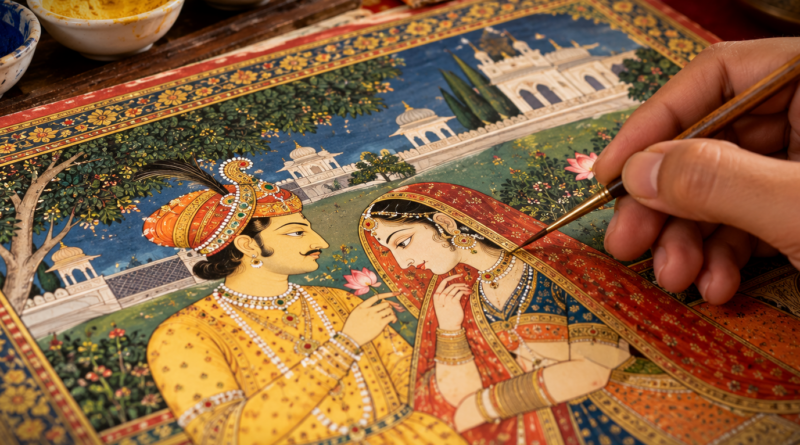
Rajasthan, the land of royal palaces, magnificent forts, colourful festivals, and vibrant traditions, has contributed immensely to India’s artistic and cultural heritage. Among its most remarkable artistic achievements is Rajasthani miniature painting, a traditional art form celebrated for its intricate details, brilliant colours, expressive figures, and fascinating depictions of royal life, mythology, nature, and romance. These paintings are more than decorative works of art; they are visual records of the beliefs, lifestyles, emotions, and historical experiences of the people who created them.
Developed and refined over several centuries, Rajasthani miniature painting flourished under the patronage of royal courts and noble families. Artists transformed small surfaces into elaborate compositions filled with extraordinary detail. Despite their limited size, these paintings communicate powerful stories through carefully arranged figures, architectural settings, landscapes, and symbolic colours.
The tradition reflects a unique combination of indigenous artistic practices, religious influences, regional customs, and interactions with other painting styles. Different kingdoms developed distinctive approaches, allowing the art form to evolve into several schools with individual characteristics.
Today, Rajasthani miniature paintings remain an important part of India’s cultural identity. Their enduring appeal lies in their ability to preserve the artistic imagination of earlier generations while inspiring contemporary artists, collectors, researchers, and admirers of traditional craftsmanship.
The Historical Origins of Rajasthani Miniature Painting
The history of Rajasthani miniature painting developed through a gradual process rather than a single moment of invention. Its foundations can be connected with older Indian traditions of manuscript illustration, religious imagery, mural painting, and decorative art. Artists across the region inherited techniques that emphasised storytelling, symbolic representation, and the careful arrangement of figures.
Religious manuscripts played an important role in the development of small-format painting. Illustrated Jain texts, particularly those produced in western India, demonstrated how artists could communicate complex religious ideas through compact compositions and carefully controlled lines. These earlier traditions helped establish artistic practices that later influenced regional painting styles.
During the medieval period, Rajasthan consisted of several kingdoms and princely territories, each possessing its own political ambitions, religious traditions, and cultural preferences. Royal courts increasingly became important centres of artistic production. Rulers invited painters to decorate manuscripts, record important events, illustrate literary works, and create images for palaces and private collections.
As artistic exchanges expanded, painters encountered influences from neighbouring regions and different courtly traditions. These interactions encouraged experimentation while allowing regional identities to remain visible.
By the sixteenth and seventeenth centuries, distinctive Rajasthani painting schools had developed in several centres. Their artists shared certain characteristics, including vibrant colours, decorative backgrounds, and narrative compositions, but each court cultivated its own visual language.
Royal Patronage and the Growth of Artistic Traditions
Royal patronage was one of the most significant factors behind the flourishing of Rajasthani miniature painting. Kings, princes, nobles, and wealthy patrons commissioned artworks to express their interests, celebrate their achievements, and demonstrate their appreciation of literature, religion, and culture.
Paintings were frequently produced in court workshops where artists worked under the supervision of experienced masters. The process could involve several specialists, with different individuals contributing to drawing, colouring, ornamentation, and finishing. Such collaboration helped maintain consistent standards while allowing apprentices to learn established techniques.
Royal commissions included portraits, hunting scenes, military processions, court ceremonies, festivals, and illustrations of important historical events. These subjects offered artists opportunities to display their technical abilities while documenting the world surrounding their patrons.
Religious and literary subjects were equally important. Stories associated with Krishna, Rama, and other figures from Indian traditions inspired elaborate visual narratives. Poetic works describing love, separation, longing, and devotion provided further opportunities for artistic interpretation.
Patronage also encouraged regional experimentation. A ruler interested in music might commission paintings illustrating different musical moods, while another might favour hunting scenes or elaborate palace gatherings. As a result, the character of a painting school often reflected the tastes and cultural ambitions of the court that supported it.
Major Schools of Rajasthani Miniature Painting
Rajasthani miniature painting encompasses several regional schools. Although they share historical connections, their differences in colour, composition, figure design, and subject matter reveal the diversity of Rajasthan’s artistic heritage.
1. Mewar School
The Mewar tradition is especially associated with bold colours and expressive storytelling.
The Mewar school, centred around areas including Udaipur and Chittorgarh, is among the most recognisable traditions of Rajasthani painting. Its works often feature strong outlines, vivid reds and yellows, simplified architectural structures, and expressive human figures.
Religious narratives occupy an important place in Mewar painting. Artists illustrated episodes from the Ramayana, the Mahabharata, and Krishna’s life, presenting familiar stories through lively compositions.
Landscapes in these paintings are frequently stylised rather than strictly realistic. Hills, trees, rivers, and buildings are arranged to support the narrative and create a visually balanced scene.
The Mewar school demonstrates how artists could communicate emotion and movement without relying on realistic perspective. Its direct visual language gives many works a distinctive energy and clarity.
2. Marwar School
The Marwar school developed in western Rajasthan, particularly around Jodhpur and neighbouring centres. Its artistic identity reflects the region’s royal culture, local traditions, and historical connections with other parts of northwestern India.
Marwar paintings often portray rulers, nobles, court ceremonies, processions, and hunting expeditions. Portraiture became an important subject, allowing artists to record the appearance, clothing, and authority of prominent individuals.
Strong colours, decorative textiles, elaborate jewellery, and carefully rendered weapons contribute to the visual richness of these works. Certain paintings also depict village life, religious celebrations, and regional customs.
The Marwar tradition reveals how miniature painting served both artistic and documentary purposes. Alongside their decorative qualities, these images preserve impressions of royal ceremonies, clothing styles, and social practices.
3. Bundi School
The Bundi school is admired for its imaginative landscapes, flowing compositions, and attention to the natural environment. Developed in southeastern Rajasthan, it is especially associated with paintings of gardens, monsoon clouds, rivers, forests, and palace architecture.
Nature often plays an active role in Bundi compositions rather than serving merely as a background. Trees, flowering plants, animals, and dramatic skies help establish mood and movement.
Many works explore themes of love, music, devotion, and the changing seasons. The relationship between human figures and their surroundings creates a sense of atmosphere that distinguishes Bundi painting from some of the more formally structured court styles.
Its artists demonstrated remarkable skill in combining intricate decorative details with expansive natural settings.
4. Kota School
The Kota school, closely related historically to Bundi, became particularly renowned for its hunting scenes and depictions of wildlife. Artists portrayed tigers, deer, elephants, horses, and other animals within dense forests and carefully observed landscapes.
Hunting compositions often contain numerous figures and animals moving through the scene. Their arrangement creates a sense of action while demonstrating the painter’s ability to control complicated visual details.
Kota paintings also include portraits, courtly activities, and scenes of everyday life. The school’s interest in animals and natural environments gives it a distinctive place within the wider Rajasthani tradition.
5. Kishangarh School
The Kishangarh school is especially famous for its elegant figures, delicate facial features, graceful gestures, and lyrical atmosphere. Its development reached a celebrated stage during the eighteenth century under royal patronage.
One of its best-known artistic associations is the idealised female figure commonly identified as Bani Thani. Her elongated face, arched eyebrows, almond-shaped eyes, and refined features became emblematic of the school’s distinctive aesthetic.
Krishna and Radha frequently appear in Kishangarh paintings, where spiritual devotion is expressed through beauty, distance, longing, and romantic symbolism.
Soft colours, carefully arranged landscapes, and slender figures create an atmosphere of poetic refinement. The Kishangarh school demonstrates how miniature painting could transform religious devotion and romantic emotion into a highly stylised visual experience.
6. Jaipur School
The Jaipur school developed under the patronage of rulers of the Amber and Jaipur courts. Its artists produced portraits, religious illustrations, court scenes, architectural views, and ceremonial compositions.
Compared with some other regional styles, Jaipur paintings can display a strong interest in formal arrangement, decorative refinement, and detailed representations of courtly life.
Royal clothing, jewellery, furnishings, and architectural elements are often rendered with considerable care. The paintings reveal the importance of ceremony, social rank, and aesthetic presentation within the court.
The Jaipur tradition also reflects artistic exchanges that took place between Rajasthan and other major centres of painting. Its development illustrates how regional schools could absorb outside influences without losing their individual character.
Themes and Subjects in Rajasthani Miniature Paintings
The variety of subjects found in Rajasthani miniature painting is one of its greatest strengths. Artists drew inspiration from religion, literature, music, nature, politics, and everyday experiences.
Religious narratives: Stories of Krishna, Rama, and other revered figures provided a rich source of imagery. These paintings helped communicate religious teachings and made familiar narratives visually accessible.
Love and devotion: Romantic and devotional themes often explored separation, reunion, longing, beauty, and emotional attachment. Radha and Krishna became particularly important figures in this tradition.
Royal life: Portraits of rulers, court gatherings, processions, and celebrations recorded the ceremonial world of princely Rajasthan.
Nature and seasons: Monsoon clouds, flowering gardens, rivers, birds, and animals helped establish the mood of a painting. Seasonal changes were also connected with poetry, music, and human emotion.
Music and poetry: Some paintings represented musical modes and associated moods, linking visual art with other cultural traditions.
Hunting and warfare: These scenes displayed royal power, physical movement, and the artist’s ability to depict complicated arrangements of people and animals.
Together, these themes reveal a tradition that connected spiritual beliefs, courtly identity, literary imagination, and observations of the natural world.
Colours, Materials, and Artistic Techniques
The technical excellence of Rajasthani miniature painting depends on careful preparation, controlled brushwork, and patience. Traditional artists worked with materials selected for their availability, durability, and visual qualities.
Paintings were produced on surfaces such as handmade paper, prepared cloth, and, in some earlier traditions, palm-leaf manuscripts. The surface was carefully prepared to create a smooth foundation for drawing and painting.
Traditional pigments could be obtained from minerals, plants, and other natural materials. Depending on the workshop and period, artists used reds, yellows, blues, greens, whites, and blacks to create distinctive combinations. Gold and silver were sometimes incorporated into works requiring luxurious ornamentation.
Fine brushes made from soft animal hairs or other suitable fibres enabled artists to produce delicate lines. Tiny details in jewellery, textiles, facial features, and foliage required steady hands and extensive practice.
Artists commonly began with a preliminary drawing before applying colour in successive stages. Outlines, layered pigments, decorative details, and finishing touches gradually transformed the initial design into a complete composition.
Rather than depending entirely on naturalistic perspective, many painters used overlapping forms, changes in scale, and carefully arranged architectural elements to establish space. This approach prioritised narrative clarity and symbolic meaning.
The result was an artistic language in which every line, colour, and decorative element could contribute to the story.
Cultural Significance and Historical Value
Rajasthani miniature paintings are important cultural records because they preserve visual information about societies that existed centuries ago. They offer insights into clothing, jewellery, architecture, musical instruments, religious practices, courtly ceremonies, and the relationship between rulers and their surroundings.
However, these paintings should not be treated as straightforward photographs of the past. Artists often idealised their subjects, followed established conventions, or emphasised symbolic meanings. Their historical value becomes greater when their artistic purpose and cultural context are considered together.
The paintings also demonstrate the close relationship between visual art and literature in Indian culture. Poems, religious texts, and musical traditions frequently inspired images, creating connections between different forms of creative expression.
Furthermore, regional schools reveal that Rajasthan’s cultural heritage was never entirely uniform. Each centre developed its own preferences while participating in a wider network of artistic exchange.
Preserving these works therefore means protecting not only beautiful objects but also the knowledge, beliefs, and creative practices associated with their production.
Challenges in Preserving the Tradition
Despite their cultural importance, traditional miniature paintings face several challenges. Older works may deteriorate because of humidity, temperature changes, exposure to light, dust, and unsuitable storage conditions.
Fragile paper and sensitive pigments require careful handling. Museums and conservation specialists must balance public access with the need to protect delicate surfaces from further damage.
Another challenge is the transmission of traditional skills. Producing miniature paintings requires years of practice, yet changing economic conditions can make it difficult for artists to depend entirely on this craft for their livelihoods.
Modern commercial demand may also encourage simplified designs that do not fully reflect the complexity of traditional techniques.
Supporting skilled artisans, documenting workshop practices, providing training opportunities, and creating sustainable markets can help maintain the tradition. Museums, educational institutions, collectors, and cultural organisations all have a role to play.
Digital documentation and carefully managed exhibitions can further increase public awareness while reducing unnecessary handling of fragile originals.
Rajasthani Miniature Painting in the Modern World
Rajasthani miniature painting continues to influence contemporary artistic practice. Many artists preserve traditional subjects and methods, while others experiment with modern themes, new compositions, and different materials.
Workshops and training programmes help introduce younger generations to the discipline required for fine brushwork and detailed illustration. Exhibitions also allow audiences to appreciate the diversity of regional schools and understand their historical development.
The art form has applications beyond traditional painting. Its decorative patterns, floral motifs, architectural designs, and distinctive figure styles inspire textiles, book illustrations, interior decoration, and contemporary visual design.
Nevertheless, innovation should not erase historical understanding. Learning about the origins, symbolism, and techniques of miniature painting enables artists and audiences to appreciate its complexity more fully.
Responsible cultural tourism can also support local craftspeople when visitors purchase authentic work, attend educational demonstrations, and respect the communities that maintain these traditions.
The future of Rajasthani miniature painting depends on combining preservation with meaningful opportunities for artistic development.
Conclusion
The rich heritage of Rajasthani miniature paintings represents one of India’s most distinctive artistic achievements. Through delicate brushwork, luminous colours, elaborate ornamentation, and carefully constructed narratives, generations of artists transformed small surfaces into remarkable expressions of cultural life.
The Mewar, Marwar, Bundi, Kota, Kishangarh, and Jaipur schools demonstrate the diversity of the tradition. Each developed characteristic approaches to storytelling, portraiture, landscapes, religious devotion, and royal representation.
Beyond their visual beauty, these paintings preserve valuable evidence of historical customs, literary traditions, religious beliefs, and artistic relationships. They reveal how creativity flourished through the interaction of skilled artisans, royal patrons, and regional cultures.
Protecting this heritage requires conservation, education, financial support for artists, and greater public appreciation. Traditional techniques must be passed to future generations while allowing contemporary practitioners to explore new possibilities.
Ultimately, Rajasthani miniature painting is more than a reminder of Rajasthan’s royal past. It is a living artistic legacy that connects history with imagination and demonstrates the extraordinary power of human creativity to preserve cultural identity across generations.